Is sales commission wages in Thailand? Severance, rate cuts and commission plans that can change
Many salespeople earn a modest salary and most of their income from commission. When the job ends, the first question an employer has to answer is whether severance is worked out on the salary alone or on salary plus commission. And when the business needs to change commission rates, how far can the employer go on its own? Below are the rules Thai law and the Supreme Court have laid down, and a way to design a commission plan that works in practice.
Commission is wages
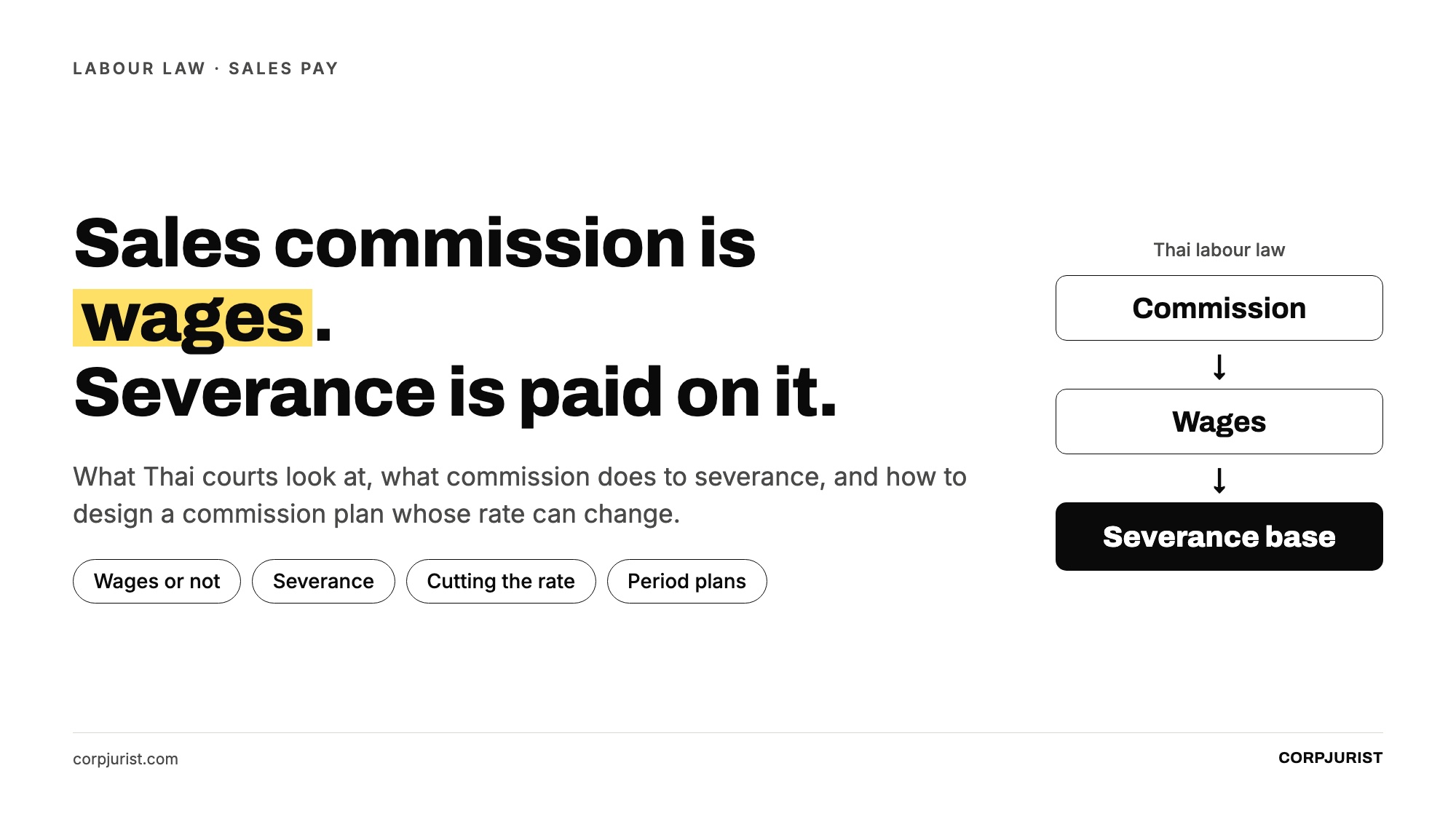
Sales commission is wages. Section 5 of the Labour Protection Act Buddhist Era (B.E.) 2541 (1998) defines wages to include money “paid by calculation on the output the employee achieves in normal working hours of a working day”. Commission calculated on an employee’s own sales falls squarely within that definition.

Not paid every month, still wages
The Supreme Court has held that sales pay calculated on results is wages, even though in a month with no sales the employer pays nothing at all. An amount that varies does not stop it being wages.
A sales target condition, still wages
One employer introduced a new rule: a sales team head earned commission only after reaching at least 70% of target, and the employer then argued the commission was an incentive. The court disagreed. Hitting sales targets and collecting payment from customers is already the salesperson’s job.
The court looks at why money is paid, not what it is called
Money paid in return for work is wages. Money paid to encourage diligence or lift morale is not. Call it commission, brokerage or a per-trip fee: the result is the same.
A bonus is different from commission
A bonus paid only to staff still employed at the end of the accounting period, based on a manager’s appraisal and announced as a morale payment, has been held not to be wages. Commission calculated on each employee’s own sales by a fixed formula sits on the other side of that line.
What this means for the employer
Because commission is wages, it goes into the base for severance. If it is paid late, the employer owes interest at 15% a year under section 9. If the employer withholds it wilfully and without good reason, a further 15% of the outstanding amount is added every seven days once seven days have passed.
Working out severance when there is commission
Severance is length of service multiplied by wages. An employee who has worked continuously for at least 120 days and is then dismissed is entitled to severance under section 118. The number of days depends on length of service.
| Length of service | Severance |
|---|---|
| 120 days, under 1 year | 30 days’ wages |
| 1 year, under 3 years | 90 days’ wages |
| 3 years, under 6 years | 180 days’ wages |
| 6 years, under 10 years | 240 days’ wages |
| 10 years, under 20 years | 300 days’ wages |
| 20 years or more | 400 days’ wages |

A worked example
A salesperson with 2 years 6 months’ service earns a salary of 20,000 baht and average commission of 40,000 baht a month. That is wages of 60,000 baht a month, or 2,000 baht a day. Ninety days’ severance comes to 180,000 baht. On salary alone it would be only 60,000 baht. That 120,000 baht difference is where disputes usually start.
No Supreme Court decision settles the averaging period
Section 118 sets two bases: the last wage rate for employees generally, and the wages for the final stretch of work for employees paid by output in units, which for the length of service in our example means the last 90 days. An employee on salary plus commission sits between the two. Work it out both ways, as a 12-month average and over the last 90 days, and keep 12 months of payslips as evidence.
Severance arises when the employer ends the employment
An employee who resigns gets no severance. Termination under section 118 means the employer does not let the employee keep working and does not pay wages, whether because the contract has ended or for any other reason.
Grounds for not paying severance must be in the termination letter
An employer can withhold severance only on the grounds in section 119, for example a breach of work rules or a lawful order after a written warning. The facts behind the ground must be stated in the termination letter, or told to the employee at the time of dismissal. Otherwise the employer cannot rely on that ground later.
Other money due on dismissal
Severance is not the only payment. And because commission is wages, anything calculated on wages should include commission too.

Pay in lieu of notice
For a contract with no fixed term, notice must be given in writing on or before a payday, to take effect on the next payday (section 17). Without notice, the employer pays the wages the employee would have earned up to the date the termination would have taken effect, on the day the employee is sent home (section 17/1). For monthly staff this can be one to two months’ wages, depending on the date notice is given.
Pay for unused annual leave
Under section 67, an employer who dismisses for a reason other than a section 119 ground must pay for the current year’s leave pro rata. Carried-over leave must be paid in every case, even when the employee resigns.
Damages for unfair dismissal
If a dismissal has no reasonable cause, the employee can claim damages on top, under section 49 of the Act on the Establishment of and Procedure for Labour Court B.E. 2522 (1979), even if severance has been paid in full. The court sets the amount it sees fit.
Late payment carries interest
Interest at 15% a year under section 9 applies to severance, pay in lieu of notice under section 17/1 and unpaid wages, commission included.
Why an employer cannot cut commission rates on its own
Commission is a condition of employment. Section 5 of the Labour Relations Act B.E. 2518 (1975) defines “conditions of employment” to include wages. Changing them to the employee’s disadvantage needs the employee’s consent.

A cut without consent does not work
The Supreme Court has held that reducing wages changes the conditions of employment. The employer cannot change them against the employee, even by management order. It can do so only with the employee’s agreement.
Company regulations and announcements cannot be rewritten alone either
One employer handed out meeting minutes to cancel an annual reward granted under an existing regulation. The court found nothing had changed and the regulation still applied. Changing an agreement on conditions of employment needs consent, or the labour demand procedure under section 13 of the Labour Relations Act.
Renaming it an incentive does not help
As above, the court looks at how the money is actually paid. A new target rule or a new name leaves commission as wages.
Do not dismiss staff who refuse new terms
The Supreme Court has held that an employee who refuses an order changing conditions of employment to their disadvantage has not breached a lawful order. An employer who dismisses for that reason owes severance, pay in lieu of notice and damages for unfair dismissal.
Designing a commission plan you can re-rate
Set rates by period. The approach we recommend is to announce each commission rate for a fixed period, such as six months or a year. When the period ends, the employer announces the rate for the next one. The new rate sets the terms of a new period; it does not take away a right the employee already has. The Supreme Court has held that an employee’s entitlement to a benefit follows the terms of the regulation that grants it, but no decision yet deals with a period-based commission plan directly. That is why the conditions below matter.

Agree the period system from day one
The employment contract, or the commission plan the employee signs, should say that commission rates are set per period by the company’s announcement for that period. If an existing contract fixes a rate with no period, moving to the period system is itself a change to conditions of employment, and current staff must consent to it once.
Leave no gap
Also state that if a period ends before a new announcement, the old rate continues until there is one. Commission is wages, and a period with no rate becomes an unpaid wages dispute.
Announce before the period starts, forward-looking only
Give written notice ahead of time, for example 30 days before the period begins, and never apply a new rate to sales already made.
Review the rate genuinely each period
If the same rate is re-announced every period for years, an employee may argue it has become a condition of employment. Each announcement should rest on a business reason such as product margin, price or market conditions, and the review should be kept on file.
Apply it to everyone in the same role
Announce by role or by team, not person by person. Cutting one individual’s rate looks like victimisation, and section 14/1 of the Labour Protection Act lets the court enforce an employment contract, regulation or order that gives the employer an unreasonable advantage only to the extent that is fair and reasonable.
Get a signature every period
Ask staff to sign each announcement as “acknowledged and agreed”. A signature is the clearest evidence of consent. Do not treat carrying on working after an announcement as consent: we have found no Supreme Court decision that accepts it.
Earned commission cannot be cut
Commission on closed sales is wages due. Section 76 bars deductions from wages except in the cases the law lists, and late payment carries interest under section 9.
Keep the base salary fixed
Only the commission formula moves, and total pay must stay at or above the minimum wage.
Keep rate figures out of the work rules
Put only the method for setting rates in the work rules, and keep the numbers in each period’s announcement. Otherwise every rate cut needs consent or the labour demand procedure.
With a union or an agreement reached through a labour demand
Section 20 of the Labour Relations Act bars employment contracts that conflict with such an agreement unless they are more favourable to the employee. Changing commission then has to go through the demand procedure under section 13.
Keeping incentive pay outside wages
It can be done, but only by changing what the money is; a new name is not enough. The court asks whether the money is paid in return for work or to motivate. To keep a payment outside the wage base it has to be a genuine incentive, and that comes at the cost of a weaker push to sell.

Payments the court has held are not wages
A bonus paid only to staff still employed at the end of the accounting period, based on a manager’s appraisal and announced as a morale payment, is not wages, even when calculated as a fixed amount on salary. An annual reward for diligent staff with no absence, leave or lateness is not wages either.
Features that help keep it outside wages
Paid quarterly or yearly, not with each salary payment. The recipient must still be employed on payout day. It depends on appraisal or on team or company results, not on individual sales alone. The company holds a real discretion and actually uses it. The written purpose is to motivate or reward.
Features that pull it back into wages
Calculated on each person’s sales by a fixed formula, paid with salary, and payable every time the condition is met. The courts have held payments like these to be wages, even when not paid every month and even with a sales target condition.
Splitting it out to avoid the rules does not work
The Supreme Court has held that an employer who split cost-of-living pay out of normal wages, simply so it would not count in other calculations, was still paying wages. A separate payslip line or a new name does not change the result.
What works in practice: two parts
The first part is individual commission at a lower rate, accepted as wages and re-rated by period as described above. The second is an incentive bonus on team or company results, paid at the company’s discretion, which sits outside the wage base. This structure reduces the severance base while keeping the incentive to sell.
”Still employed on payout day” cannot apply to commission
That condition works for a discretionary bonus. Commission on closed sales is wages due, even if the employee resigns or is dismissed before payday.
Changing your commission plan, or facing a severance dispute?
This has to be set up right from the first employment contract. Send the contract or commission plan you use now to info@corpjurist.com and we will tell you plainly where the risks are and what to fix first. More on our employment and labour practice.
This article is general legal information, not advice on any particular case. The outcome of each case depends on its own facts and documents.
Tell us what you're working on.
Send us your situation and we'll point you to the right next step. A real lawyer reviews what you send.
Thanks. A lawyer will be in touch, and we'll point you to the right next step.