Nene Royal won America's Got Talent: a case of trademark strategy for the music industry
Summary: Nene Royal, the 16-year-old guitarist from Phuket, won America’s Got Talent (AGT) in September 2026. The natural next step for any new star is commercialisation: tours, recordings, merchandise and sponsorship, all sold under one name. The trademark is the part of the intellectual property (IP) portfolio that makes that name an asset you can own, license and defend. Her public filing record is a working case study. It shows her management company filing in the United States (US) and Thailand, a Thai individual filing a “NENE ROYAL” logo for printed T-shirts fifteen days after her audition aired, and how Thailand’s first-to-file system treats that difference.
This is a legal lesson built from public records. The applications discussed are pending, no authority has decided anything about them, and nothing here says that any person has acted unlawfully.
1. From AGT champion to brand: why commercialisation starts with a trademark
Winning a talent show turns an artist into a name that people will pay for. The money rarely comes from the prize alone. It comes from what gets sold under the name afterwards: concert tickets, streams and records, T-shirts and caps, fan-club memberships, brand deals. Every one of those products carries the artist’s name or logo, and the trademark is the legal right that decides who may put that name on goods and services, and who may stop others from doing it.
That is why the trademark belongs at the centre of an artist’s IP portfolio from day one, not after the first bootleg T-shirt appears. Nene Royal’s case shows both sides: a management company that filed quickly in the US, and a first-to-file system at home in Thailand where someone else got to the register first.
2. Who is Nene Royal, and how did she get to AGT?
Nene Royal is the stage name of Rattikarn “Praew” Amloy, a rock singer and guitarist born in 2010 in Phuket. She started on guitar at six or seven, largely self-taught from online videos, and began busking as “Nene Royal” at about twelve, most often at Phuket’s Naka Weekend Market, and with two local bands, OZONE and Miniheart. Her YouTube channel, created in 2020, grew from 624 subscribers in May 2023 to 311,000 in June 2026, according to archived captures of the page. Before AGT she had appeared on the Thai television show Super 10 and came second in the Overdrive Guitar Contest in 2023. The 1978 Ibanez guitar she played at AGT was a 2024 gift from a Danish supporter who first saw her at the Phuket markets.
Her early supporter and manager. Thai media report that her manager, Jon Elron, first saw her playing at Naka Market in early 2023 and went on to help plan her career. TNN Thailand, the English service of the Thai News Network (TNN), reported that Elron is an executive of Black Lotus Global LLC, a Florida limited liability company (LLC) set up to support Nene Royal’s business and brand. Her official website’s terms say the site and its store are owned and operated by Black Lotus Global LLC. The reports say her team applied to AGT more than once before she was accepted.
The AGT run. Her audition, a cover of The Cranberries’ “Zombie”, aired in the US on 7 July 2026 and earned four yeses from the judges. The National Broadcasting Company (NBC), which airs the show, reported it as the most-watched audition of the season. She advanced through Howie Mandel’s Judges’ Callbacks with Muse’s “Hysteria”, received Mel B’s Live Golden Buzzer in the quarterfinal for Soundgarden’s “Black Hole Sun”, played The White Stripes’ “Seven Nation Army” in the final on 22 September, and was named the winner on 23 September, the show’s first Thai champion. She is booked to open for Avenged Sevenfold in Singapore on 13 October 2026.
3. Why is a trademark such an important part of an artist’s IP portfolio?
An artist’s IP portfolio usually has three layers. Copyright protects the songs, the recordings, the artwork and the videos. Trademarks protect the name, the logo, and sometimes a mascot or a slogan, as signs that identify whose goods and services these are. Personal rights protect the person’s own name and image. Contracts decide who owns and controls each layer.
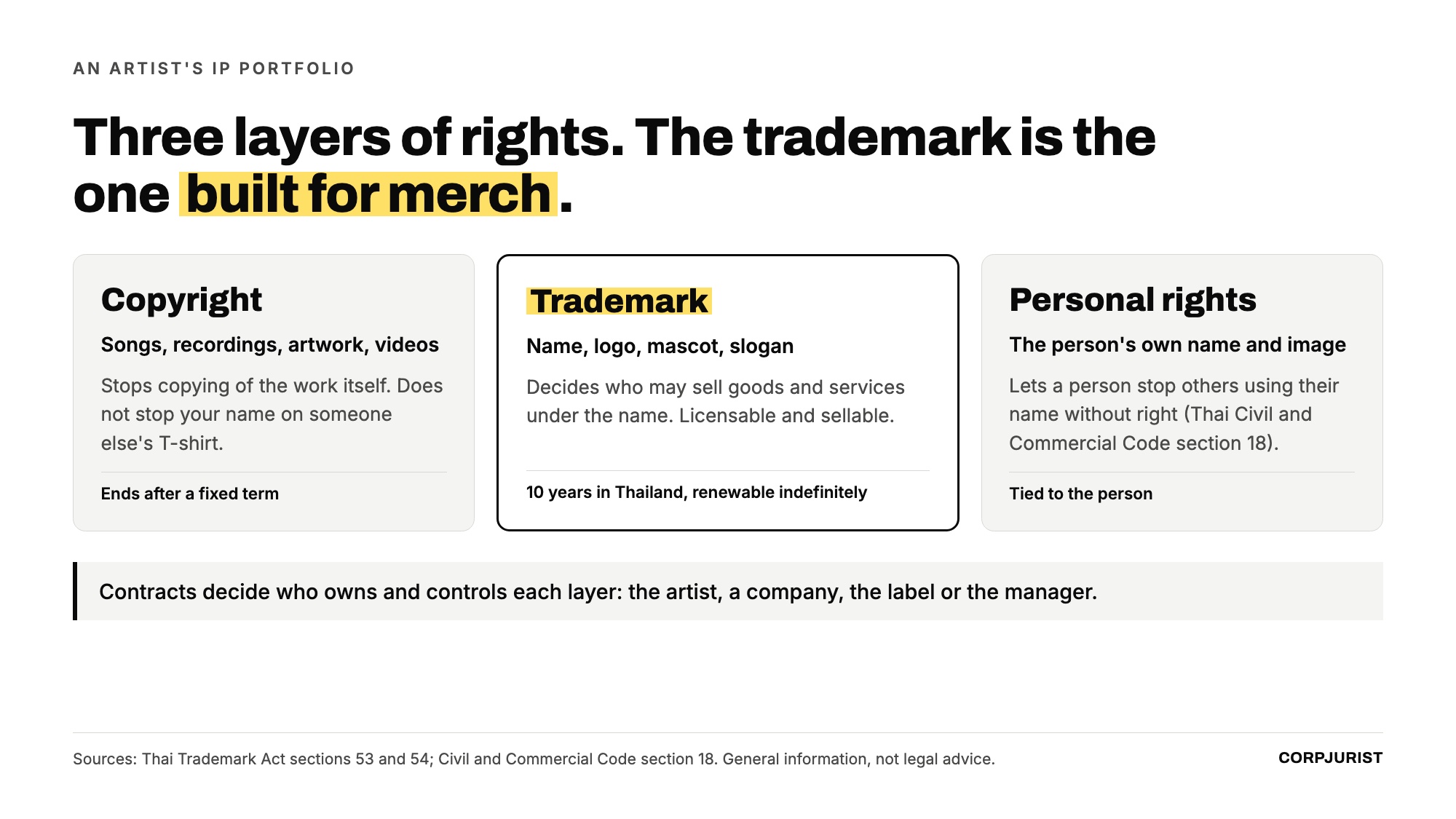 The trademark layer decides who may sell goods and services under the name.
The trademark does jobs the other layers cannot:
- It is the right that covers merchandise and services. Copyright in a song does not stop someone printing your name on a T-shirt. A trademark registration for clothing does.
- It can last indefinitely. A Thai registration runs for ten years and can be renewed again and again (sections 53 and 54 of the Trademark Act). Copyright ends; a used and renewed trademark does not.
- It is what you license and what buyers pay for. Merchandise deals, sponsorships, and even whole-catalogue sales are built on registered marks.
- It is territorial. A registration protects you only in the country that granted it, so the portfolio has to follow the touring and merchandise map.
Stage name or real name?
In Thailand a person’s name can be registered as a trademark, but it is treated with care. Under the examination manual of the Department of Intellectual Property (DIP), first names, including the first names of famous people, are distinctive only when shown in a special manner, and famous surnames are treated as ordinary surnames. The same manual says pen names and stage names are not surnames, so the famous-surname rule does not catch a stage name like “Nene Royal”; how it is classified otherwise is for the examiner. The Act requires the person’s consent before someone else registers their signature or picture (section 7), and the Civil and Commercial Code lets a person demand that others stop using their name without right, and seek an injunction (section 18).
The practical point for an artist: register the stage name, decide in writing who will own the registrations, and if a company holds them, put the person’s consent and the terms of any later transfer on paper.
4. What do the best-run rock bands do with their trademarks?
We compared eight rock bands on five tests: who owns the name, how wide the portfolio is, who controls the recordings and publishing, how the band enforces, and how it earns from the IP. One stood out: Metallica.
Metallica keeps every layer in its own hands. We searched the WIPO Global Brand Database by owner name and found 180 records filed by the band. The numbers show a portfolio built on purpose.
- Who owns it. All 180 records name “Metallica”, the band’s own partnership, as owner, not a member or the label.
- When. The earliest registration on record dates from 1993, in Germany, and the first US registrations followed in 1994. The band has kept registering since, and 2026 is its busiest year so far, with 14 registrations, half of them for the album title MASTER OF PUPPETS.
- What. The 162 live records (152 registered, 10 pending) cover 26 classes. The most-covered are clothing (49 records), recordings (47), printed goods and posters (38) and live performances and fan clubs (36), followed by drinkware (18), jewellery (16) and bags (15). Besides the name, the band files sub-brands such as BLACKENED, FIFTH MEMBER and MASTER OF PUPPETS, and separate devices such as its ninja star.
- Where. 25 offices, including WIPO’s international register, led by the US (96 records), the UK (17), the EU (11), and Chile, Singapore and Paraguay (7 each). In the EU it has also registered designs for its logos. We found no record in Thailand in that database.
Ownership of the recordings follows the same logic. A 1994 renegotiation with Warner meant its master recordings came back to the band in 2012, and it now runs its own label. It has acted against uses of its name on unrelated goods, including a lip pencil in 1999.
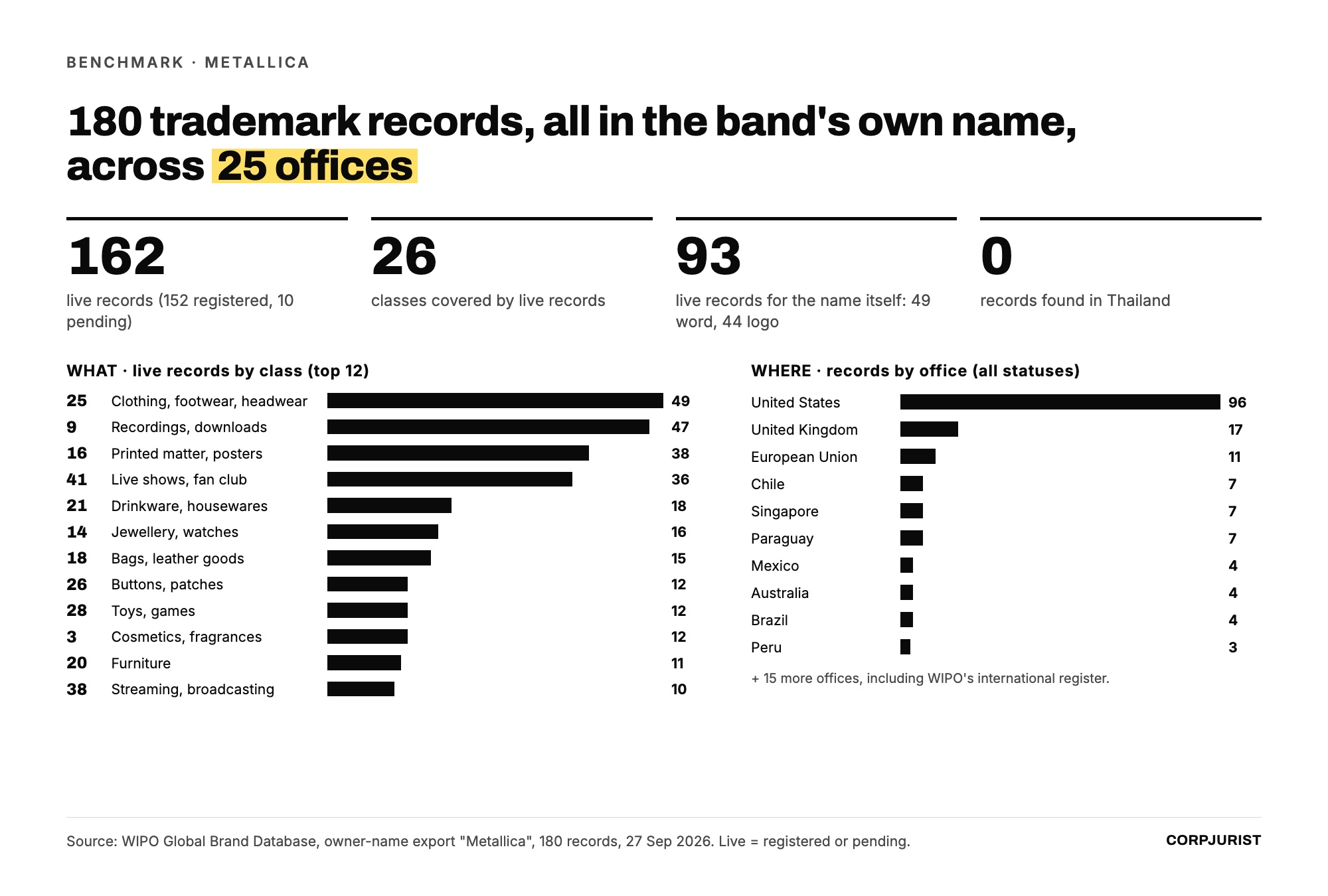 Metallica’s trademark record at a glance: who owns it, what it covers, and where.
The word and the logo: does Metallica’s filing maximise protection?
The band files its name twice. Of the 162 live records, 93 are for METALLICA itself: 49 as the plain word and 44 as the lightning-bolt logo, filed as it appears on the merchandise. The two do different jobs.
- The word mark protects the name. It covers METALLICA in any lettering, on a website, as a domain or spoken aloud, so a copier cannot get round it by changing the font.
- The logo mark protects the look. It covers the lightning-bolt lettering that a bootleg T-shirt actually copies, and it matches what the band really sells, so use is easy to prove. But a logo registration covers only the design as filed, which is why the record holds at least three versions: the classic logo, an outline version, and one set against the ninja star.
Does it maximise protection? In the core markets and classes, yes. In the US the band holds both in seven classes: recordings (9), jewellery (14), printed goods (16), bags (18), drinkware (21), clothing (25) and live shows (41). The UK and the EU hold both for recordings, printed goods and clothing. Outside that core the pairing is uneven. In the US, toys, furniture, patches and floor mats rest on the word alone, and guitar picks and gift cards on the logo alone. Singapore and Mexico hold only the word; Paraguay and Peru hold only the logo. These gaps look like budget choices rather than mistakes: the word alone still stops use of the name, and the logo alone still stops a copy of the look.
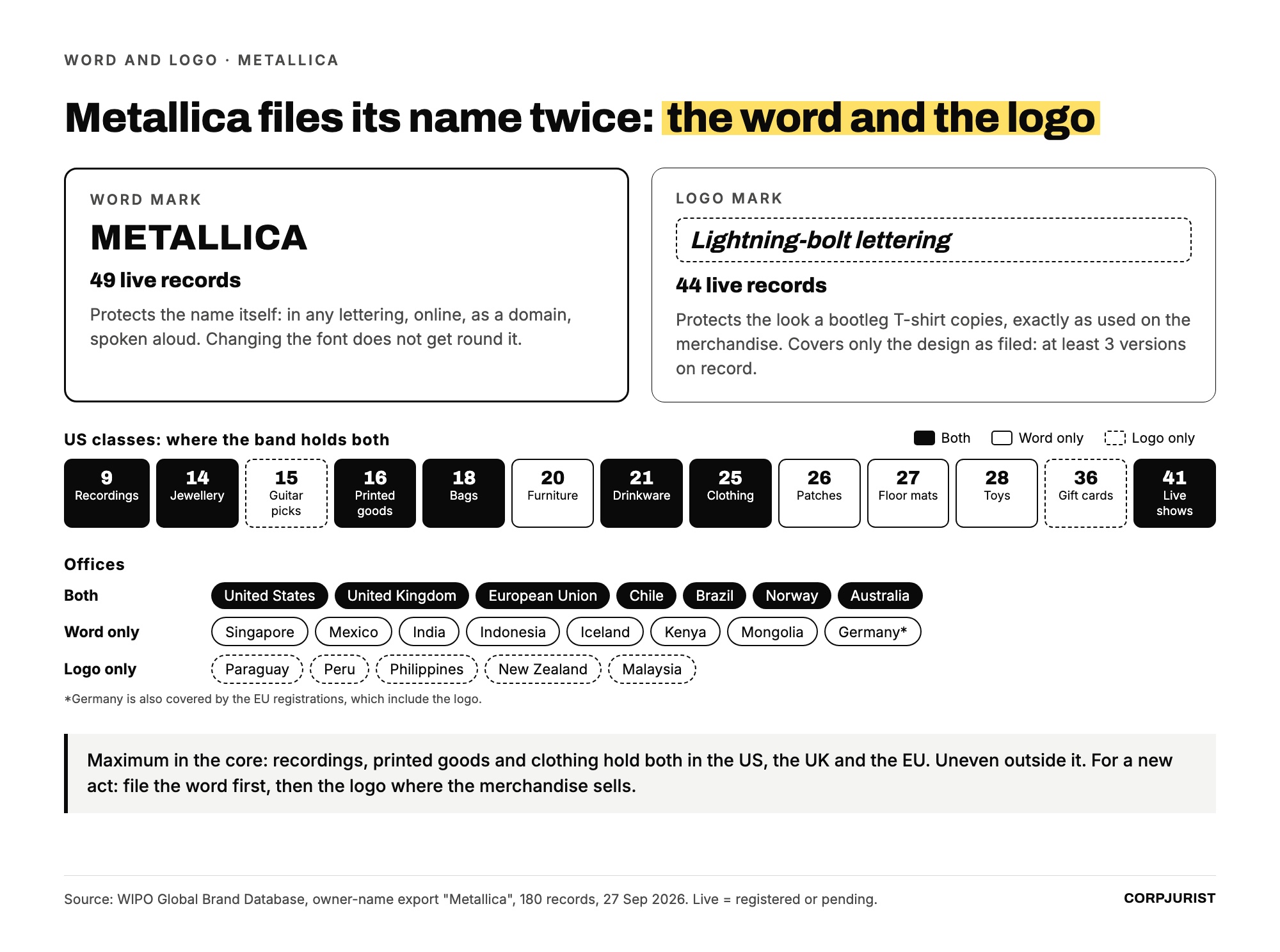 Word and logo: what each protects, and where Metallica holds both.
The lesson for a new act: file the word first, because it covers the most, then file the logo in the classes where merchandise sells, once the design is final and the designer has assigned it. It matters in this case, because the Thai “NENE ROYAL” application in section 5 is for stylised lettering, not only the name.
Three cautionary notes from other bands
- Clear the name first. Linkin Park lost the name Hybrid Theory to an earlier band called Hybrid before its first album, and spelled “Linkin” to get the “.com” domain.
- Take the logo in writing. The Rolling Stones paid their tongue-logo designer £50 in 1970, then paid £26,000 in 1984 to buy the copyright.
- Not everything is a trademark. Gene Simmons of KISS applied to register the “devil horns” hand gesture in June 2017 and abandoned it eleven days later.
5. What has been filed for “Nene Royal”?
We searched the World Intellectual Property Organization (WIPO) Global Brand Database (GBD) on 27 September 2026 for every record matching “NENE ROYAL” and “NENE” exactly, and read the record pages for the ones that matter. GBD data can lag national registers, so treat this as a snapshot.
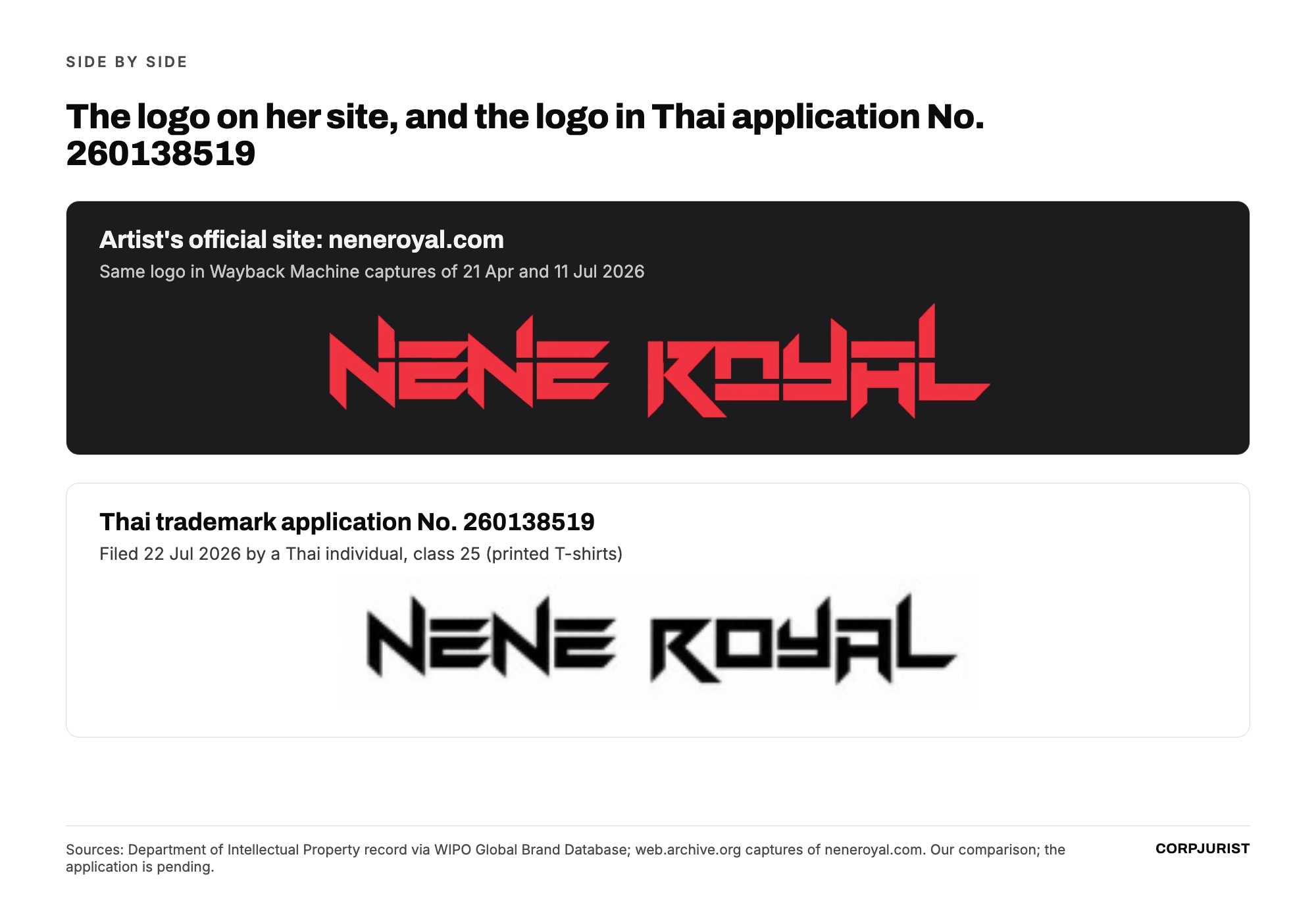 Top: the logo on neneroyal.com, seen in Wayback Machine captures from April and July 2026. Bottom: the mark on Thai application No. 260138519, filed 22 July 2026. In our side-by-side comparison the lettering appears to be the same.
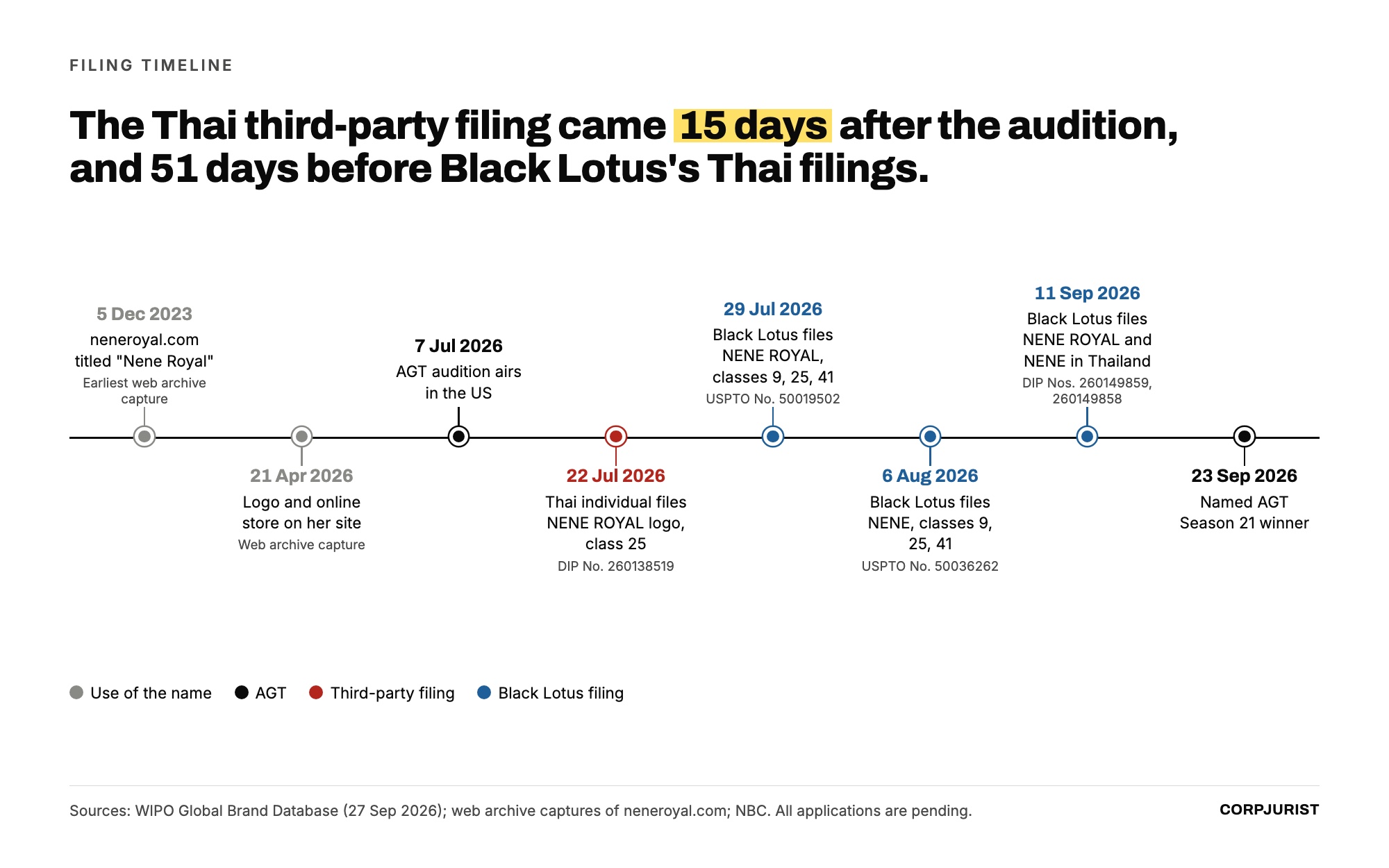 The Thai third-party filing came 15 days after the audition aired, and 51 days before Black Lotus’s Thai filings.
Every “NENE ROYAL” filing on record
| Filed | Office and number | Applicant | Classes | Goods and services | Status |
|---|---|---|---|---|---|
| 17 Mar 2024 | Korea, registration 4024127050000 | An individual in Korea | 25 | Shirts of many kinds, T-shirts, sweatshirts, hoodies, and men’s, women’s and children’s shoes | Registered 5 Sep 2025, expires 2035 |
| 22 Jul 2026 | Thailand, DIP, No. 260138519 | A Thai individual | 25 | Printed T-shirts (เสื้อยืดพิมพ์ลาย), stylised lettering | Pending |
| 29 Jul 2026 | USPTO, No. 50019502 | Black Lotus Global LLC | 9, 25, 41 | Downloadable music; shirts, T-shirts, hats; live musical performances, fan clubs, webcasts, podcasts, music video production | Pending, word mark |
| 11 Sep 2026 | Thailand, DIP, No. 260149859 | Black Lotus Global LLC | 9, 25, 41 | Downloadable music and video; T-shirts, caps, hats; music and video production, live music, fan clubs, websites | Pending |
Black Lotus Global LLC also filed the shorter mark NENE, in the same three classes, at the USPTO on 6 August 2026 (No. 50036262) and in Thailand on 11 September 2026 (No. 260149858).
The Korean registration was filed in March 2024, well before the audition, and nothing on the record connects it to the artist. It still matters: it covers the clothing class in Korea, so Nene Royal merchandise sold there under that name would run into a registered right held by someone else.
“NENE” marks that could block the shorter name
There are 141 exact “NENE” records worldwide. Most are dead or sit in unrelated classes such as cosmetics, beer or hygiene products. The live ones that touch recordings, clothing or entertainment, and whose goods we read, are these:
| Office and number | Owner | Classes | Relevant goods and services | Status |
|---|---|---|---|---|
| Japan, reg. 4845939 | NHN (Japan) | 41 | Planning and running music performances, musical performance, broadcast programme production (stylised mark) | Registered 2005, expires 2035 |
| UK, UK00003243232 | Nene Overland Ltd | 21 classes incl. 9, 25, 41 | Compact discs (CDs), digital versatile discs (DVDs), speakers; clothing incl. T-shirts, caps and hats; vehicle-related events | Registered 2017, expires 2027 |
| European Union (EU), 003780285 | Laboratorios Indas | 5, 10, 16, 25 | Clothing for babies and children, underwear, protective clothing | Registered 2009, expires 2034 |
| EU, 018771994 | An individual in Italy | 9 | Spectacles and sunglasses (not music) | Registered 2023 |
How to run this check on your own name. Everything in this section is an availability search: find the exact and near matches on the register, sort them by class, owner and status, then read them against the goods you plan to sell. Macopano, a trademark availability tool built by a Thai trademark lawyer, is being made for this step on a Thai filing. When it opens, it will take the search you already ran, or run the conflict screen across your classes and the classes next to them, and draft an availability report for a lawyer to review. It will be an indicative screen, not a clearance of every register, and the call on registrability stays with the lawyer and, in the end, the registrar. Macopano is taking waitlist sign-ups at macopano.ai.
6. What does the filing record mean under Thai law?
Thailand gives the right to whoever files first, and that rule is the whole story of this record.
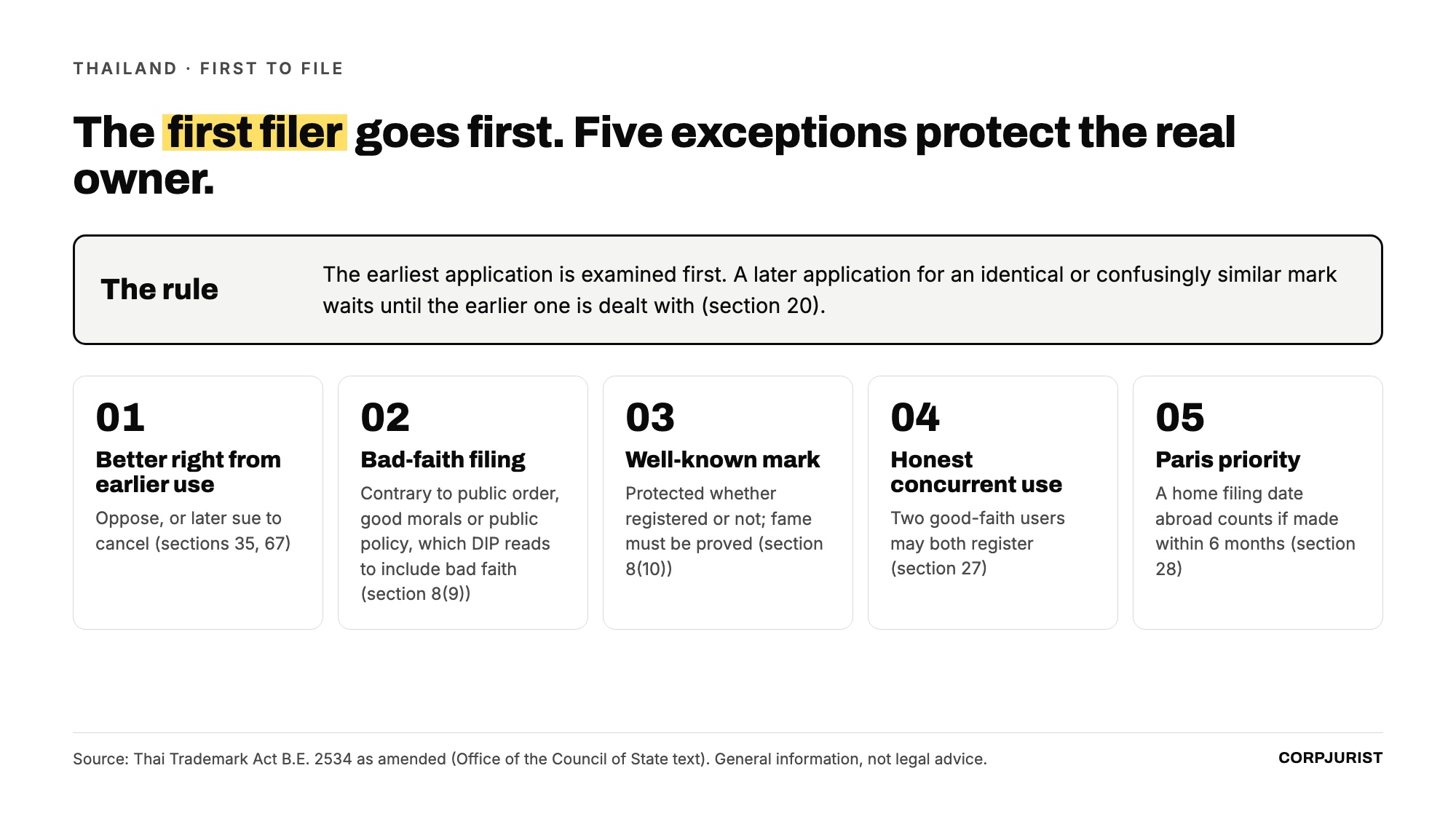
In Thailand the right goes to whoever files first, and you can file for a mark you have not used yet. DIP examines the earliest application first; a later application for an identical or confusingly similar mark waits in line until the earlier one is dealt with (section 20). The system has exceptions, and they are what protect a real owner who filed second:
- A better right from earlier use. An owner who used the mark before the other side filed can oppose the application, or later ask the court to cancel the registration, on the ground of a better right (sections 35 and 67).
- Bad faith. Section 8(9) bars marks contrary to public order, good morals or public policy. DIP’s manual reads public policy as also covering bad-faith conduct in registration that no other ground catches, so a dishonest filing can be refused under it. But the manual tells examiners to examine normally where the copied mark was not registered in Thailand, so the owner usually has to raise it.
- Well-known marks. A mark that is well known can be protected whether or not it is registered (section 8(10)), but fame has to be proved with evidence of renown in Thailand.
- Honest concurrent use. Two owners who both used a similar mark in good faith can both be registered (section 27). This helps honest parallel users, not a copier.
- Paris priority. A foreign applicant can claim its home filing date for a Thai application filed within six months (section 28), but it only helps if that date is earlier than the competing Thai filing.
What the Thai Supreme Court has said. The courts have applied these exceptions consistently. The owner who used the mark first can have the better right, including a foreign brand whose goods reached Thailand before the Thai filing, but that protection needs use in Thailand. An exact copy is hard to explain away: where an applicant registered a foreign designer’s name letter for letter, the Court treated the filing as bad faith. Music has been here before. In a 1995 decision under the previous Act, the company of The Beach Boys stopped a Thai application for “BEACH BOYS” for clothing: the Court found an intent to imitate for unfair gain and cancelled the pending application, but would not stop the applicant’s use because the band’s mark was not registered in Thailand. Distributors, resellers and employees who filed an owner’s mark have lost. And there are limits: the five-year deadline for court cancellation is applied strictly, a claim of fame fails without solid evidence, and undated website printouts carry little weight.
A note on the United States. The US starts from the opposite rule: trademark rights there come mainly from use, not from filing first. On the record we searched, Black Lotus’s NENE ROYAL application is the earliest US filing for the name.
What the record says about the strategy
Read as a strategy, the record has real strengths. The US filing came quickly, it covers the three classes a touring act needs (recordings, clothing, performance), and the short form NENE was filed alongside the full name. The gaps are just as visible. In Thailand, the artist’s home market, the first filing on her side came after a third party’s. We found no Madrid Protocol registration and no Singapore filing, where she plays in October, in the GBD on 27 September 2026. None of the Black Lotus filings is for the logo: the US applications are word marks, and the Thai records carry no figurative classification, unlike the third-party application. In Korea the clothing class is already registered to someone else, and “NENE” on its own meets earlier registrations in Japan (music performance), the UK and the EU (clothing). “NENE ROYAL” is the stronger mark to build on. The site, owned and operated by Black Lotus, lists the name and stage name “Nene Royal” among intellectual property that belongs to “the Company, the artist, or third parties”, without saying which. Holding the brand in a company is common and often sensible; what matters is a written agreement that says who owns what, and what happens to it later.
7. Someone filed your name before you did. What can you do?
In Thailand
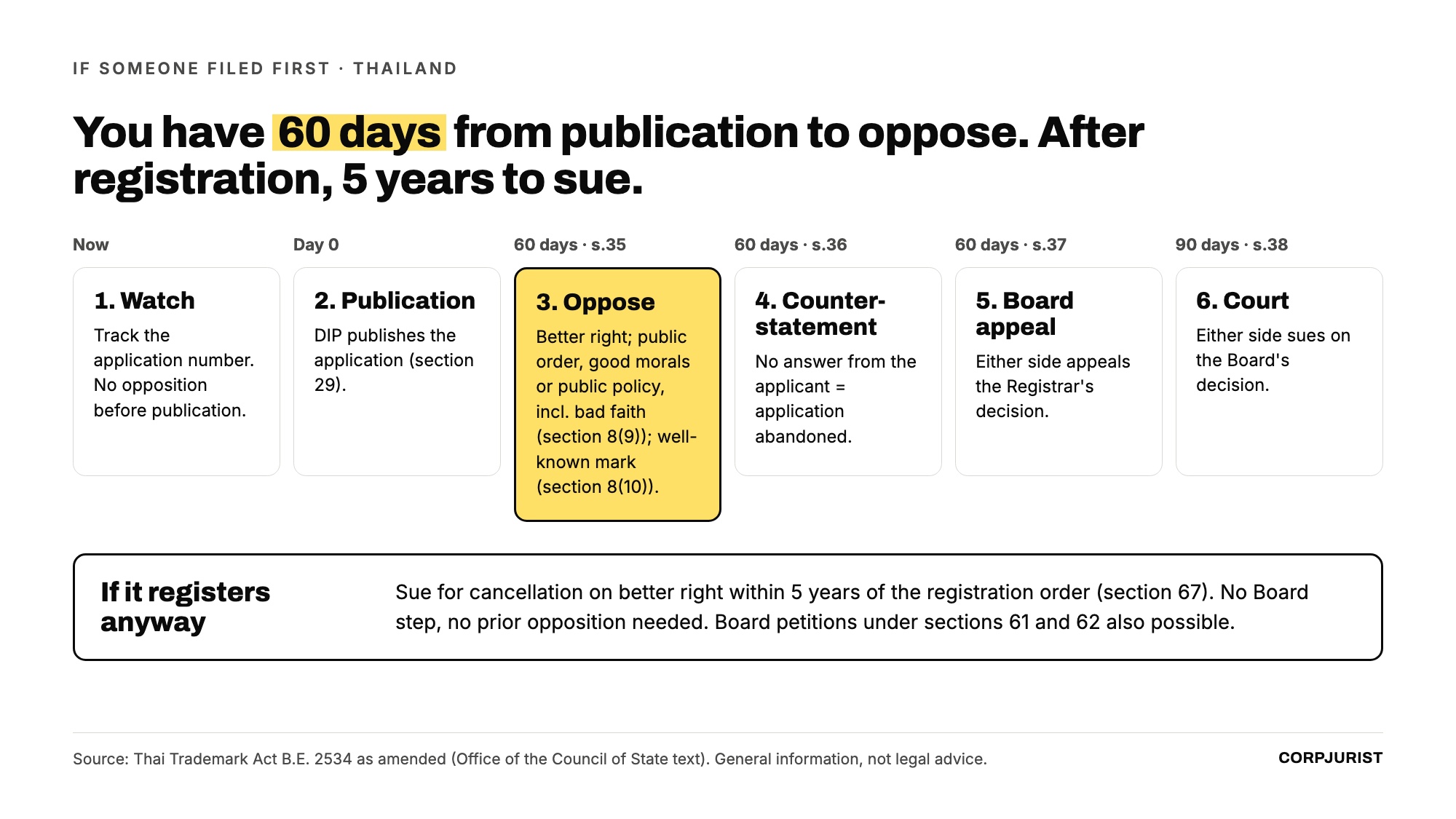
- Watch the register. You cannot oppose before DIP publishes the application. Put the application number on a watch.
- Oppose within 60 days of publication (section 35). Any person can oppose, on a better right, on the ground that the mark cannot be registered (which brings in section 8(9), marks contrary to public order, good morals or public policy, including a bad-faith filing, and well-known marks under section 8(10)), or on non-compliance with the Act.
- If the applicant does not answer, the application falls. An applicant who files no counter-statement within 60 days of receiving the opposition is treated as having abandoned the application (section 36). Either side can appeal the Registrar’s decision to the Board of Trademarks within 60 days, then to court within 90 days (sections 37 and 38).
- If it registers anyway, go to court within five years. An interested person can ask the court to cancel for better right within five years of the Registrar’s registration order (section 67), without petitioning the Board first and without having opposed. Board petitions on section 8 grounds and public order are also available (sections 61 and 62).
- Use passing-off where it fits. The owner of an unregistered mark can sue someone who passes off goods as theirs, but only for the goods the owner actually sold under the mark (section 46, paragraph two).
- Consider a commercial fix. Many of these disputes end in an assignment of the application, a licence, or a coexistence agreement. Negotiating from a prepared opposition file is stronger than negotiating from nothing.
In other countries
Each country has its own opposition and cancellation procedures and deadlines, so take local advice in every market where a competing filing appears.
Where the Thai “NENE ROYAL” application stands
The earlier application is pending and first in the queue. Once DIP publishes it, anyone with a better right has 60 days to oppose. The evidence that tends to decide these cases is dated first use, use on the same goods, and how closely the marks match. The public record shows the name in use since at least December 2023, the logo and logo T-shirts on her site before 22 July 2026, and lettering that appears the same in our comparison. What it does not show yet is sales of the logo merchandise in Thailand, or how the rights are divided between the artist and her management company. Those are the questions an opposition would have to answer, and DIP or a court will decide them, not this article.
8. Best practice: search before you file, then protect the brand actively
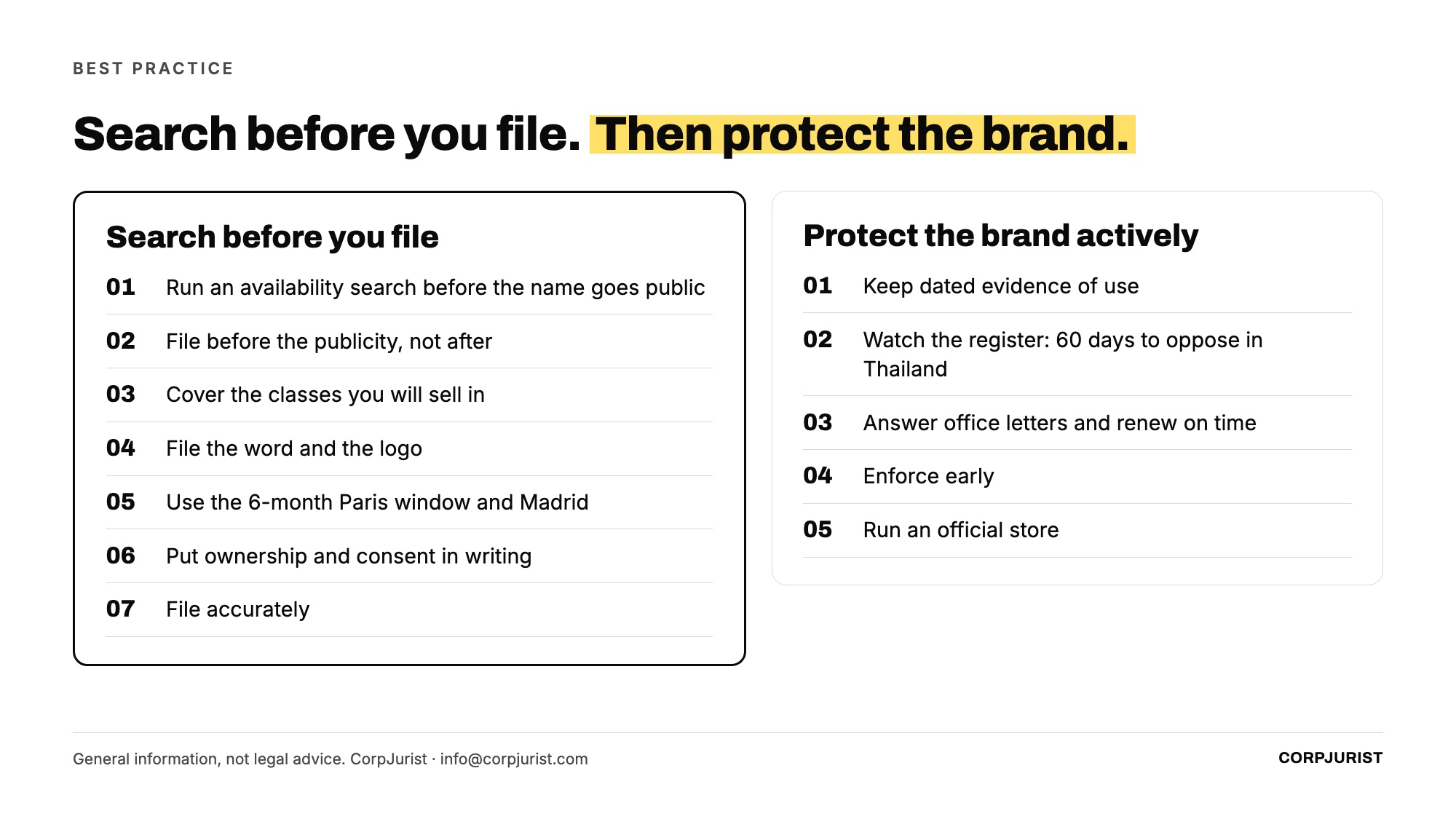
Search before you file
- Run an availability search before the name goes public. Search registered and pending marks in music, clothing and entertainment, in every country you plan to sell in, and check the domain and social handles at the same time. Macopano is being built for this step on Thai filings; the result will still need a lawyer’s read.
- File before the publicity, not after. In a first-to-file country the gap between “people know the name” and “we filed” is when a third party can get in first. Here the gap between the audition and the Thai third-party filing was fifteen days; what that timing means is for DIP or a court to weigh.
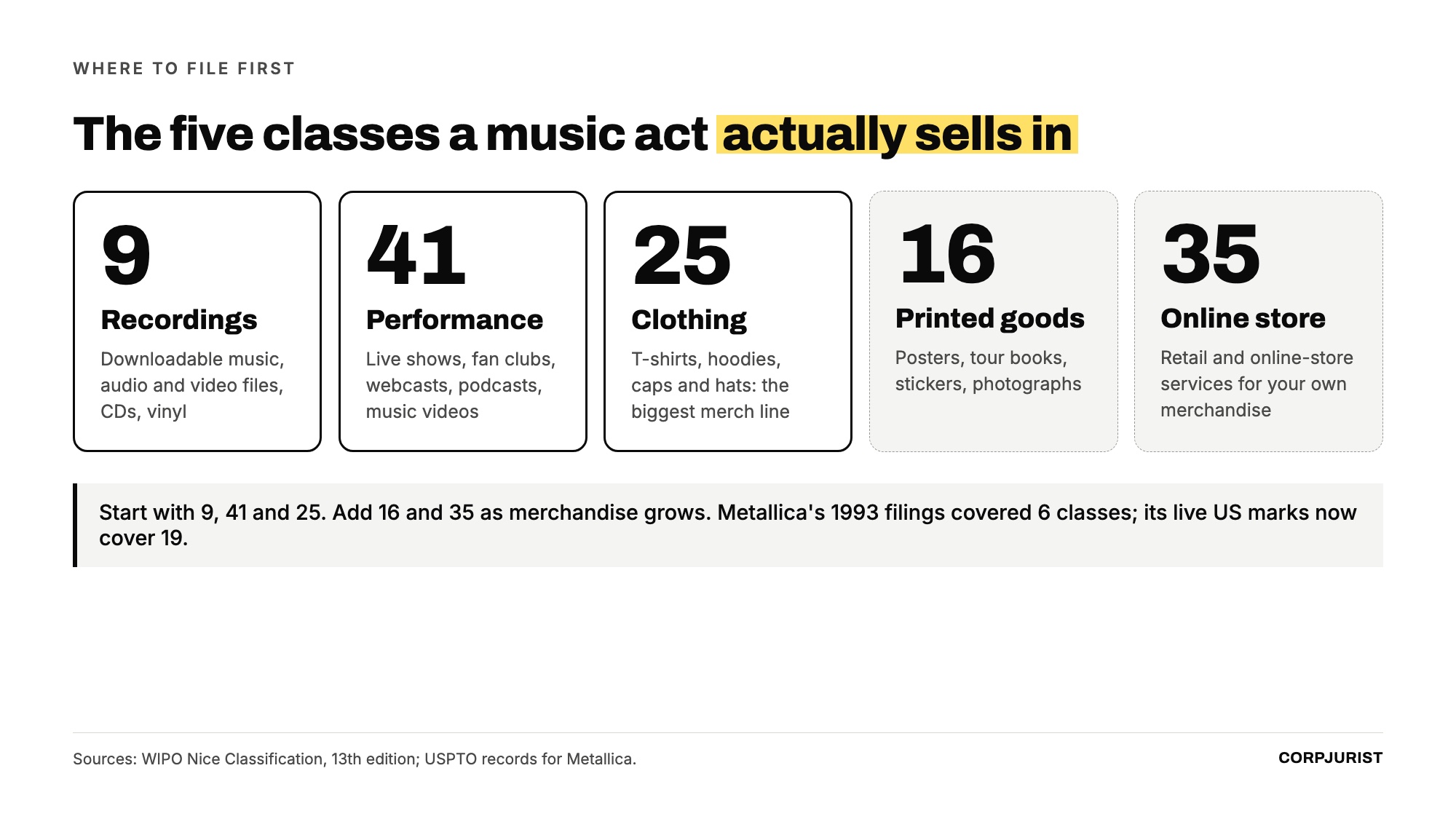
- Cover the classes you will sell in, and add classes as the business grows. Class 9 for recordings, 41 for performance and fan clubs, 25 for clothing, 16 for posters and printed goods, 35 for an online store. Metallica’s first US registrations in 1994 covered recordings, printed goods, clothing and live shows; its live records now span 26 classes.
- File the word and the logo. The word covers the name in any form; the logo covers the look that merchandise carries. Metallica holds both for its core goods.
- Use the six-month windows. A first filing at home gives six months of Paris priority abroad, and a Thai application can be the base for a Madrid Protocol filing that designates other countries.
- Put ownership and consent in writing. Decide who holds the marks, what happens when a member leaves or the management relationship ends, and, for an artist who is a minor, who signs. Get a signed assignment of the logo from its designer.
- File accurately. Every statement in an application must be true. An inaccurate filing can be attacked later and can cost you the registration.
Protect the brand actively
- Keep dated evidence of use. Invoices, shipping records, dated screenshots and archive captures. Undated printouts carry little weight in court.
- Watch the register and act inside the windows. Sixty days to oppose in Thailand, from the date DIP publishes the application.
- Keep the filings alive. Answer every office letter and file renewals and use declarations on time. Linkin Park lost its first clothing application to a missed deadline.
- Enforce early. Metallica acted against its name on a lip pencil as early as 1999.
- Run an official store. Bootlegs follow fame; Limp Bizkit launched its first official online store in 2026, a move press reports tied to bootleg merchandise.
Frequently asked questions
Who owns the Nene Royal trademark? As of 27 September 2026, no one holds a registered NENE ROYAL mark in Thailand or the US. Black Lotus Global LLC, the Florida company behind her official site and store, has pending applications in both countries. A Thai individual filed an earlier Thai application for a stylised NENE ROYAL logo for printed T-shirts, and an individual in Korea holds a registration for clothing there.
Is Thailand a first-to-file country? First-to-file, with exceptions for an owner with a better right from earlier use, bad-faith filings, well-known marks, honest concurrent use and Paris priority.
Can someone register a famous person’s stage name as a trademark in Thailand? The Thai Trademark Act has no specific ban on registering another person’s name or stage name. The real owner can still oppose on the ground of a better right (section 35), or on the ground that a bad-faith filing is contrary to public order, good morals or public policy (section 8(9)), or ask the court to cancel a registration for better right within five years of the registration order (section 67).
How long do I have to oppose a trademark application in Thailand? In Thailand, 60 days from the date DIP publishes the application (section 35).
Does filing first in the United States protect a name in Thailand? No. Trademark rights are territorial. A US filing gives six months of Paris Convention priority for a Thai application, but priority only helps if the US date is earlier than the competing Thai filing.
How do I check whether a band name is available as a trademark? Run an availability search: look for identical and similar marks, registered and pending, in the classes you will sell in (usually 9, 25 and 41), then check the owners, goods and status of each. A lawyer should read the results before you file.
Which trademark classes should a musician register first? Usually class 9 (recordings), class 41 (performances and fan clubs) and class 25 (clothing), with class 16 (posters and printed goods) and class 35 (online store) as merchandise grows.
If you run a band, manage an artist, or are about to put a name on merchandise, send us your brand name or logo and we’ll tell you where you stand before someone else files it. Email us at info@corpjurist.com.
Sources: WIPO Global Brand Database records read 27 September 2026; Internet Archive Wayback Machine captures of neneroyal.com and her YouTube channel; neneroyal.com terms and privacy policy (August 2026); reporting by Wikipedia, NBC, Loudwire, E! Online, Rolling Stone, Time Out Bangkok, The Nation Thailand, ScandAsia, TNN Thailand, TV5HD, Kapook and Thailandsun; WIPO Global Brand Database owner-name export for Metallica (27 September 2026); European Union Intellectual Property Office (EUIPO) eSearch for Metallica’s registered designs; USPTO Trademark Search and Trademark Status and Document Retrieval records for Linkin Park, LLC and Gene Simmons’s 2017 application; Thai Trademark Act Buddhist Era (B.E.) 2534 (Office of the Council of State text); DIP Trademark Examination Manual B.E. 2565; Civil and Commercial Code section 18; Thai Supreme Court decisions. This article is general information, not legal advice on any particular case.
Send us your mark
Tell us your brand and what you sell, and a CorpJurist lawyer will come back to you on what protecting it takes.
Thanks — we've got it. A CorpJurist lawyer will get back to you about your mark.