HYROX filed its trademark before it ran its first race

Summary: HYROX filed its trademark in Germany on 8 March 2018, roughly a month before it ran its first race. Eight years later it was reported sold to an LVMH-backed investor at a valuation press reports put as high as €1 billion. Its public filing record is one of the clearest worked examples you’ll find of trademark strategy driving business value, and most of the lessons transfer directly to a Thai SME.
What is a trademark strategy?
A trademark strategy is the deliberate plan for which marks you register, in which countries, and in which classes of goods and services, timed against where your business intends to go rather than where it is today. It differs from simply registering your logo: a strategy treats registrations as claims on future revenue lines, filed before you need them.
Most business owners think of a trademark as paperwork you do once the brand is working. HYROX is a useful counter-example, because you can read its entire commercial plan off a public register, often years before the product launched.
HYROX registered its brand before it had a business
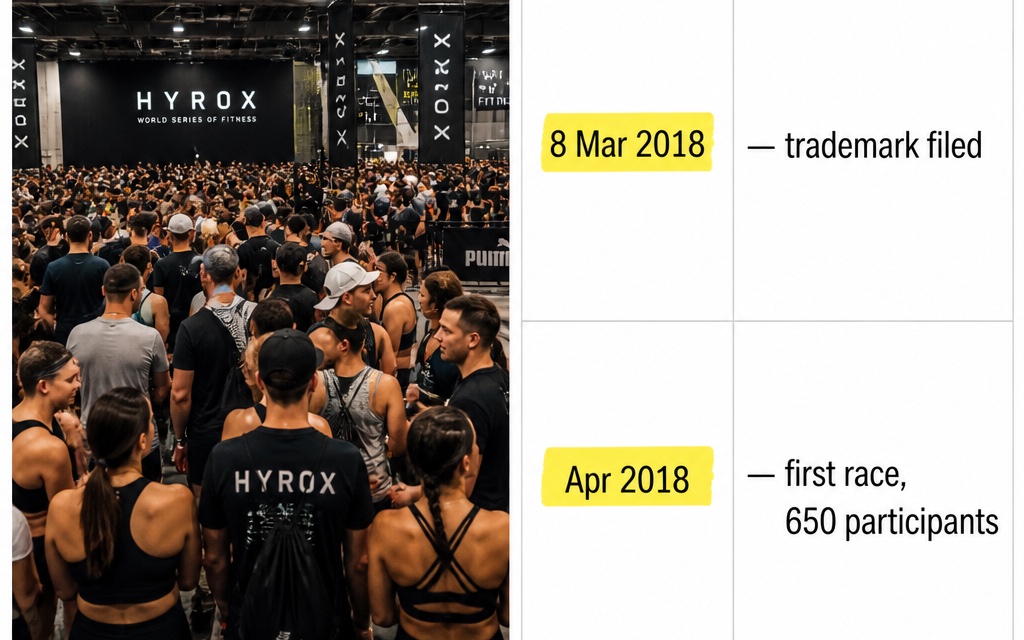 The order that matters: the application went in about a month before the first race was run.
HYROX filed its German trademark application on 8 March 2018. Its first event took place in Hamburg in April 2018, with roughly 650 participants. The trademark came first, by about a month.
More instructive is how wide it filed. That first application covered six classes: software, clothing, sporting equipment, retail and advertising, events and training, and food and drink services. At the time, HYROX was one race, in one German city, that had not yet happened.
Five of those six classes described businesses that did not exist. That is the strategy in a single decision. Filing fees at the start are small and predictable. Discovering at scale that somebody else owns your name in the category you are about to enter is neither.
The cheapest moment to claim a class is before you need it. The most expensive is after a competitor has claimed it first.
How a trademark turns a business into a licensing engine
 The sled push is one of the eight stations. Thousands of independent gyms now pay an annual fee for the right to describe their training by the brand’s name.
A registered mark is what allows you to charge other people for the use of your name. Without registration you have a request; with it you have a licence. HYROX’s gym affiliation programme is a clean illustration: independent gyms pay an annual fee to describe themselves using the HYROX name.
Trade reporting puts the licence at roughly USD 130 per month per site, with the affiliated network around 15,000 gyms as at May 2026 (Vibefam; SportsPro). HYROX supplies those gyms with no premises, no staff, and no equipment. What the gym is buying is permission to use a word.
That is why, in July 2025, HYROX registered two further EU marks on the same day: HYROX Training Club and HYROX Performance Center. Those are the two tiers of the licensing programme. A licence needs a registered mark underneath it, or there is nothing to license.
If any part of your business model involves franchising, distribution, agency, or letting a partner use your name, the registration is not administrative overhead. It is the product.
You can read a company’s expansion plan from its trademark filings
Trademark registers are public. Because a business must specify what goods and services it claims, a filing history often reveals strategy well ahead of any announcement. HYROX’s record reads as a sequence of business lines claimed in advance:
| Filed | Classes claimed | The business line it signals |
|---|---|---|
| Mar 2018 | Clothing, equipment, events, software, retail, food service | The whole eventual company, before race one |
| Mar 2024 | Supplements, protein, meal replacements, sports drinks | A nutrition range |
| Jun 2025 | Travel and tour operating services | Race tourism, sold directly |
| Jul 2025 | Training Club, Performance Center | Two tiers of gym licensing |
| Jun 2026 | Food and drink, temporary accommodation, fitness testing, drinkware, software development | Physical venues, hospitality, medical testing, an own-brand app |
Source: EUIPO register and TMview, retrieved 20 August 2026.
The June 2026 filings are the interesting ones, because none of it has launched. A mark called Haus of HYROX is under examination in the EU covering food and drink service, temporary accommodation, and fitness testing. That is a venue business, claimed on the register before a single site opens.
This cuts both ways, and it is worth saying plainly to any founder: your competitors can read your filings too. Timing a filing is a genuine strategic decision, not just a budget one.
What sponsors and investors are actually buying
Sponsorship revenue depends on exclusivity, and exclusivity depends on ownership. You cannot sell a category to a partner unless you control the name in that category.
PUMA has been associated with HYROX since the first Hamburg race and, in an announcement dated 1 October 2025, extended the partnership through 2030, including title partnership of the HYROX World Championships (PUMA newsroom). Amazfit announced a three-year global deal from 15 April 2026 covering exclusive rights across smartwatches, smart rings, smart glasses and related categories (Amazfit; Athletech News).
Competitors can build a hybrid fitness shoe, and several have. What none of them can do is build a HYROX shoe.
The same logic shows up at the point of sale. HYROX’s operating company was renamed from Upsolut Sports GmbH to HYROX World GmbH in December 2024, consolidating the brand assets into a single, cleanly named entity. Roughly eighteen months later, in July 2026, trade press reported that L Catterton, the investment firm backed by LVMH chief executive Bernard Arnault’s family office, had acquired the business; reported valuation estimates ranged from €700 million to €1 billion, with no confirmed figure disclosed (Sky News via Bloomberg; Sporting Goods Intelligence; Signalbase).
Buyers pay for assets they can see. A brand portfolio held in one named vehicle, with unopposed registrations in its core markets, is a clean diligence file. A portfolio scattered across a legacy trading name is a discount.
A trademark is not permanent unless you use it
Registering broadly is a cheap option, not a permanent entitlement. Most systems eventually require you to show you are actually using the mark for what you claimed.
HYROX’s United States registration (No. 5993005) went through a maintenance filing accepted on 16 June 2026, and the specification came back narrower. Items including belts, stationary cycles, weightlifting belts, protective supports, book publishing, equipment rental and sports camp services were removed (USPTO records).
That is the system working as intended. Claim wide at the start, then surrender what you never commercialised.
The mechanism differs by country, and the difference matters if you are filing in Thailand. The United States asks you to declare your use at fixed intervals. Thailand does not: there is no periodic declaration to file. Instead, a Thai registration that goes unused for three years is exposed to cancellation for non-use, brought by someone else who wants the name. The exposure is the same, but nobody sends you a reminder. Plan for it either way: a wide filing buys you optionality for several years, not forever.
When growth outruns your filings
 Thailand hosted the largest HYROX event in Asia this month. The Thai trademark applications behind it are still pending.
Here is the tension in the story, and it is the most useful part for anyone operating in Thailand.
HYROX staged what organisers described as the largest HYROX event ever held in Asia at Bangkok’s Queen Sirikit National Convention Center from 13 to 16 August 2026, with more than 22,000 participants reported (TTG Asia; Time Out Bangkok). Thailand had already hosted events in May 2025 and March 2026.
As recorded on TMview on 20 August 2026, HYROX’s three Thai trademark applications were all still shown as pending.
Even a brand of that sophistication can arrive in a market before its rights do. And Thailand is a first-to-file jurisdiction, which is precisely where that gap matters most. Under the Trademark Act B.E. 2534 (1991), the person who files first is generally in the stronger position, regardless of who used the name first elsewhere in the world. Reputation abroad is not a substitute for a Thai registration.
If you are planning to enter Thailand, the filing should lead the launch, not follow it. Running a trademark search in Thailand before you commit to a name is the step that prevents the expensive version of this problem.
Five practical rules from the HYROX filing record
- File before you launch, not after you succeed. The cost gap between the two is enormous, and it only moves in one direction.
- Claim the classes your business plan implies, not just the ones you trade in today. HYROX claimed food service in 2018 and opened the door to it in 2026.
- If anyone will ever use your name under licence, registration is the asset. Franchise, distribution and affiliate models do not work without it.
- File in the country before you sell in the country. Especially in first-to-file jurisdictions like Thailand.
- Keep the portfolio in one clean entity. It matters at every fundraise, sale or partnership, and it is far cheaper to do early.
How CorpJurist helps
We handle trademark filings, oppositions and portfolio management in Thailand, and we advise on international brand protection through the Madrid Protocol. If you are naming something now, or expanding into Thailand with a brand that already trades elsewhere, the useful conversation is the one before you commit.
Send us your brand name or logo and we’ll come back to you on where you stand. You can also reach Tim directly at parin@corpjurist.com.
Frequently asked questions
When should I register a trademark for my business? Register before you launch publicly, not after the brand gains traction. In first-to-file jurisdictions such as Thailand, the person who files first is generally in the stronger position. Waiting until a name is successful is when it becomes both expensive and contested.
Which trademark classes should I register in? Register in the classes covering what you sell now, plus the classes your business plan realistically reaches within a few years. Trademark protection is limited to the goods and services you claim, so a narrow filing leaves adjacent revenue lines unprotected.
Can I license my brand name without a registered trademark? You can sign the contract, but you are licensing something much weaker. A licence is permission to use a right you own, and without registration your ability to enforce the terms against the licensee or anyone else is limited. That is why franchise and affiliate models are normally built on registered marks.
Does registering a trademark abroad protect me in Thailand? No. Trademark rights are territorial. A registration in the EU or United States gives you no automatic protection in Thailand. You need a Thai application, filed directly or through the Madrid Protocol.
What happens if I register classes I never use? Unused coverage is eventually lost, though the mechanism varies. Some countries require a periodic declaration of use. In Thailand there is no such filing, but a registration unused for three years is exposed to cancellation for non-use brought by a third party. A wide filing gives you several years of optionality, not permanent coverage.
Key takeaways
- HYROX filed its trademark about a month before its first event, across six classes, five of which described businesses that did not yet exist.
- Its gym licensing programme, reported at around 15,000 affiliated gyms, is trademark monetisation: the registration is what is being sold.
- Its filing record signalled nutrition, travel and hospitality businesses years ahead of launch.
- Sponsorship exclusivity and sale value both rest on clean, consolidated ownership of the mark.
- Thailand is first-to-file. File before you launch here, whatever your brand is worth elsewhere.
Sources: EUIPO register; TMview (EUIPO/WIPO); USPTO TSDR; PUMA newsroom (1 Oct 2025); Amazfit; Athletech News; Sporting Goods Intelligence; Bloomberg/Sky News; SportsPro; TTG Asia; Time Out Bangkok; North Data (HRB 144750). Register data retrieved 20 August 2026.
Send us your mark
Tell us your brand and what you sell, and a CorpJurist lawyer will come back to you on what protecting it takes.
Thanks — we've got it. A CorpJurist lawyer will get back to you about your mark.