Your brand is protected in Thailand. Abroad, it's up for grabs.
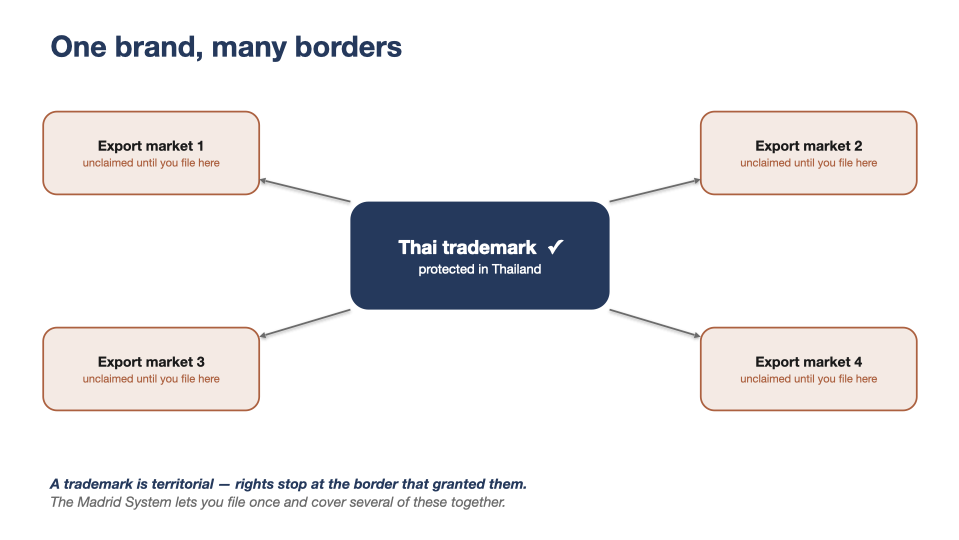
You registered your trademark at home, so the name is yours. Then you started shipping to Vietnam, Indonesia, the Gulf, maybe the US or the EU. Here’s the part most exporters don’t hear until it’s expensive: a Thai trademark stops at the Thai border. In every market you sell into, your name is unclaimed until you claim it there.
This is a plain-English guide to closing that gap: why trademarks are territorial, how the Madrid System lets you protect one brand across many countries from a single application, and how to know which markets to lock down first, before a distributor or a copycat does it for you.
Shipping abroad? Start with your Thai base. Send us your brand name or logo and your market list, and a Thai-licensed lawyer will tell you where your Thai base stands — the anchor everything abroad is built on — and what protecting it takes.
Trademarks are territorial. That’s the whole problem.
A trademark is a bit like a driving licence: it’s valid where it was issued, and it does not automatically travel with you. Your registration under the Trademark Act B.E. 2534 (1991) gives you rights in Thailand. It gives you nothing in the countries you export to. Each of those markets has its own register, its own examiner, and its own rule about who gets the name, which in most of them, as in Thailand, is whoever files first.
So picture the ways this goes wrong, because they’re not hypothetical, they’re routine:
- Your distributor or agent in an export market registers your brand in their name. Now they own your name in that country. When the relationship sours, they can block your shipments, or sell your rights back to you.
- A local copycat watches your product sell, files your mark, and either floods the market with lookalikes under your own name or waits for you to grow and then demands a ransom.
- Customs in an export market stops a container of your genuine goods, because someone else holds the registered mark there and flagged them as infringing.
Each of those ends the same way: you either walk away from a market you built demand in, or you pay far more to buy back your own name than it would have cost to register it in the first place. The forced rebrand, the legal fight, the lost shelf space: all of it traces back to one missed step.
The fix is not glamorous and it is not expensive. Decide which markets you actually sell into, check the name is clear there, and file. The Madrid System, below, is what makes doing that across several countries at once realistic instead of ruinous.
One caveat worth knowing: first-to-file isn’t a shield for bad faith. Thailand, like many of your export markets, is a member of the Paris Convention for the Protection of Industrial Property (Thailand since 2008, accession 2 May 2008), which commits members to protecting well-known marks and acting against bad-faith copying, reinforced in Thai law by the well-known-mark ground (§8(10)) and the better-right cancellation route (§67). And the courts are using it: in a 2026 decision reported by Thai media, the coffee chain Luckin Coffee defeated a local company that had registered its name and logo, winning cancellation of those registrations, an order to stop using the mark, and damages (reported at over 95 million baht), with the ruling expressly treating bad-faith registration as a ground. That’s the backstop if a distributor grabs your name, but read the fine print: it was a multi-year court battle won by a globally recognised brand, and each export market applies its own version of these rules. Proving bad faith or fame abroad is slow, costly, and uncertain, which is exactly why filing first, so you never have to, stays the cheap option.
Send us your mark, and let’s map the markets
Before you sign the next distributor deal or ship into a new country, it’s worth knowing your Thai base is solid — it’s what every foreign filing is built on. Send us the name or logo and your market list, and a Thai-licensed lawyer will come back to you: how strong your Thai base looks, which export markets are worth locking down first, and how the Madrid route would work for your specific list. From there, the searches and filings — in Thailand and abroad — are the work a lawyer signs.
Email us your mark and your markets. We’ll come back with where you’re covered and where you’re exposed.
Search vs filing: the cheap insurance, times every market
Two different jobs, and exporters feel the cost of skipping the first one across borders, not just at home:
- A trademark search (clearance) looks before you commit, to answer “is this name actually available and protectable, here and in each market I sell into?”
- A trademark filing is the application itself, lodged at the DIP (Department of Intellectual Property) for Thailand, and through the Madrid route or local counsel for everywhere else.
Filing blind into a first-to-file country is how a business pays for an application that gets refused, or that goes through and then collides with an earlier local owner. Run that risk across five export markets at once and the search stops being optional. It’s the small spend that stops five big ones.
Two reports, and a quick screen
Not every mark needs the same depth of work, and this is as true abroad as it is at home. It comes down to which question you’re actually asking:
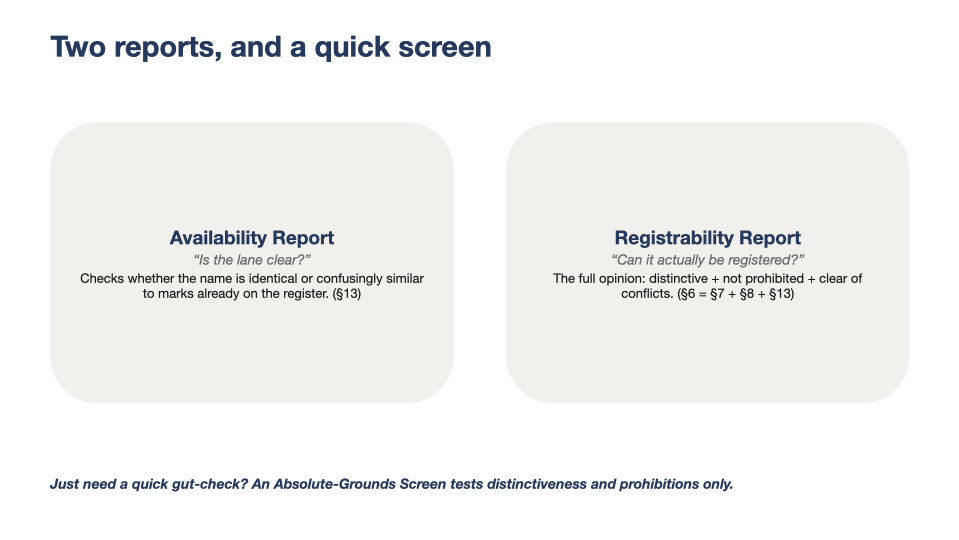
- “Is the lane clear?” → an Availability Report. This is the conflict search: is your mark identical or confusingly similar to an earlier registered, pending, or well-known mark (§13)? It’s the lighter, search-only product, and it’s the first thing to run on your Thai base before you export it anywhere.
- “Can it actually be registered?” → a Registrability Report. The full opinion under §6: is the mark distinctive (§7), not prohibited (§8), and clear of conflicts (§13)? A name that reads fine can still be refused for being too descriptive, and a mark that’s weak at home is often weak everywhere.
- Just want a quick gut-check on whether the name is even the kind of thing that can be a trademark? That’s an Absolute-Grounds Screen (distinctiveness and prohibited-marks only). Useful early, but on its own it is not clearance to file, because it hasn’t checked for conflicts.
The honest rule: a clear search is not the same as a registrable mark, and a registrable-looking name is not cleared until it’s been searched. And every export market runs its own version of these same two questions on its own register, which is exactly why “I registered it in Thailand” doesn’t answer them.
How long registration takes in Thailand, and why the Thai date matters double for exporters
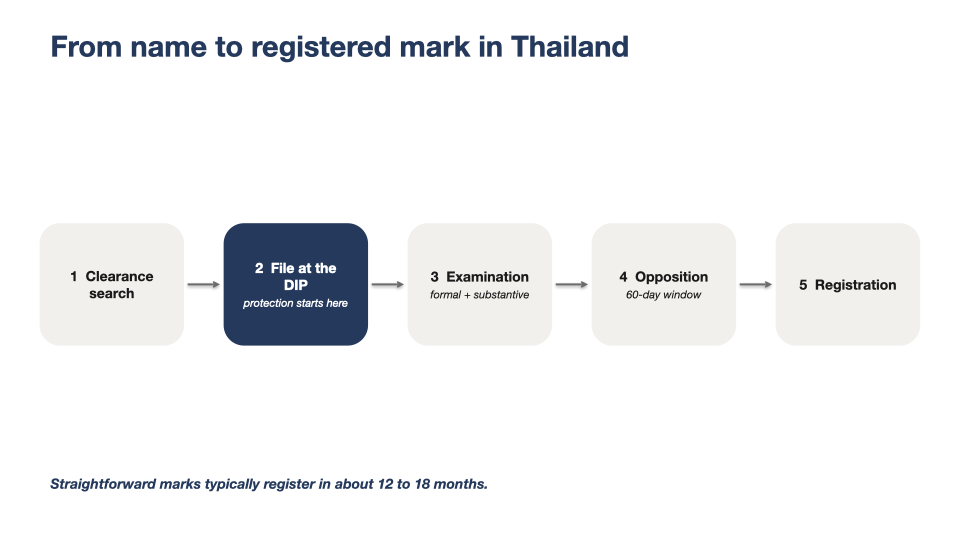
Roughly, the Thai path runs: clearance search → file at the DIP → formal and substantive examination → published for opposition (a 60-day window) → registration. In straightforward cases that’s typically around 12 to 18 months. Two things matter here, and the second one matters more for exporters than for anyone else:
- Your protection priority starts from the filing date, not the registration date. That’s the argument for filing sooner rather than waiting.
- Your Thai filing is the foundation of your whole international portfolio. The Madrid application (below) is built on your Thai application or registration. So the Thai filing date isn’t just your home priority; it’s the anchor date the rest of your export markets can claim through the Paris Convention, and the base your international registration depends on. Get the base right, and everything downstream is stronger.
And a housekeeping point that trips people up: the DIP fee is paid separately from lodging the application. Miss the fee deadline and the application can be treated as abandoned. We track that so it doesn’t lapse on a technicality and take your whole international foundation down with it.
The Madrid System, properly: one application, many markets
This is the part that matters most if you export, so here’s the real mechanism, not a slogan.
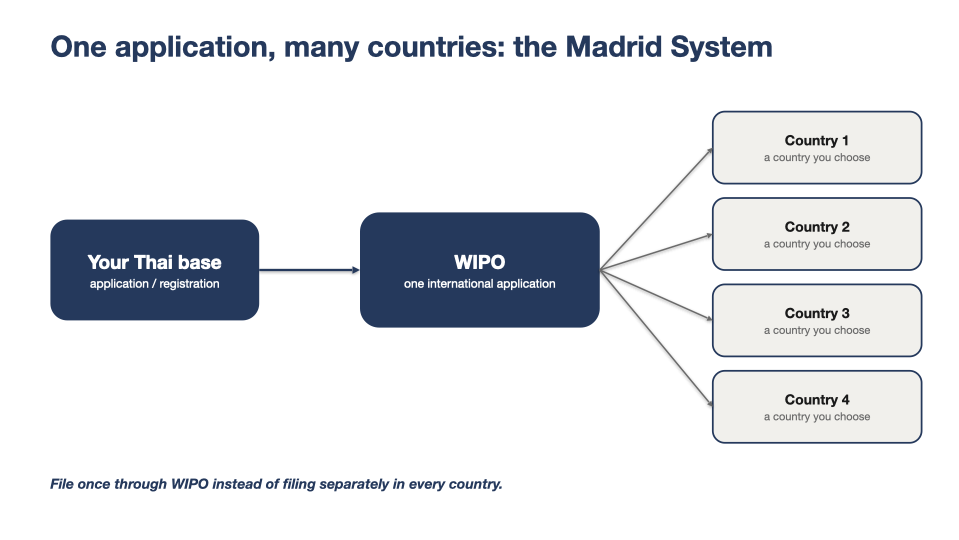
What it is. The Madrid System is an international filing route run by WIPO (the World Intellectual Property Organization). Thailand joined the Madrid Protocol with effect from November 2017. Instead of hiring counsel and filing separately in every country, you file one international application, in one language, with one set of fees, and use it to seek protection in any of the member countries you choose.
How it actually works, step by step:
- You need a Thai base first. Your international application must be founded on a “basic mark”: your Thai trademark application or registration at the DIP. No Thai base, no Madrid filing. This is why your home filing comes first and why getting your Thai registration clean matters.
- You file the international application through the DIP, which certifies that it matches your basic mark and forwards it to WIPO.
- You designate your markets. On the application you tick the member countries you want protection in, the markets you actually export to. You’re not buying “the world”; you’re choosing your lanes.
- WIPO examines the formalities and records it on the International Register, then sends the designation to each country’s trademark office.
- Each designated country then runs its own examination. This is the point exporters most often miss, so read it twice: Madrid is a filing mechanism, not a global trademark. Each office you designated applies its own law, runs its own conflict check, and can refuse your mark on local grounds: an earlier local mark, a descriptiveness objection, a local prohibition. A refusal in one country doesn’t sink the others. You get protection, country by country, in each office that accepts it.
Why exporters love it anyway: one filing instead of ten, one renewal cycle, and one place to manage the portfolio. And when you enter a new market next year, you don’t start over; you file a subsequent designation to add that country to the international registration you already have.
Two mechanics worth understanding before you rely on it:
- Paris Convention 6-month priority. If you file abroad within 6 months of your Thai filing date, that later foreign filing can claim your original Thai date. In a first-to-file world, six months of backdated priority is often the difference between owning the name and arguing about it. This is the clock that makes filing your Thai base first and moving quickly so valuable.
- The dependency period (“central attack”). For the first 5 years, your international registration stays tied to your Thai basic mark. If the basic mark is cancelled or refused within those five years, the international registration can fall with it. There’s a rescue: you can “transform” the affected designations into direct national applications, but it costs time and money. The practical lesson: a shaky Thai base puts your whole export portfolio at risk for five years, so the base is worth doing properly.
One honest limit. Not every country you export to is a Madrid member, and a few important markets sit outside the system or are awkward inside it. For those, protection means a direct national filing through local counsel. Part of the job is telling you which of your markets Madrid covers cleanly and which need a direct route.
What we deliver
No parts list, just the destinations:
- A solid Thai base — the clearance search and filing done properly, because everything abroad is built on it.
- A market-by-market plan — which of your export markets to protect, which Madrid covers, which need a direct national filing, and in what order, matched to where you actually sell.
- The international filing managed — the Madrid application through WIPO, designations and priority handled, renewals and the dependency period tracked, so the portfolio holds together as you grow.
Exporting into new markets and not sure where your name is exposed? Send me your brand and your market list, and I’ll tell you where you’re covered and where you’re naked.
Who’s behind this
CorpJurist is a licensed Thai law firm. Your trademark work, the clearance search, the opinion, the Thai filing, the Madrid application, is handled and signed by a Thai-licensed lawyer with 14 years of practice, and you deal with that lawyer directly, in English or Thai. The clearance, the opinion, and the international filing are legal work a lawyer is accountable for, start to finish.
Plans
Straightforward packages, scoped to what you actually need:
- Availability Search — is the lane clear on your Thai base before you export it.
- Registrability Opinion — the full §6 answer: distinctive, not prohibited, clear of conflicts.
- File & Register (Thailand) — end-to-end filing at the DIP with fee-deadline tracking.
- International Filing (Madrid + direct) — the export portfolio: designations, priority, the markets Madrid covers and the ones that need a direct national route, all managed.
Every package is fixed-scope with transparent inclusions and no lock-in. Request a quote and we’ll size it to your marks, your classes, and your market list.
Questions exporters actually ask
“I’ve registered in Thailand. Isn’t my brand protected in the countries I ship to?” No. Trademark rights are territorial. A Thai registration protects you in Thailand only. In every export market, your name is unclaimed until you register it there, and most of those markets, like Thailand, give the name to whoever files first.
“Do I have to file in every country separately?” For Madrid member countries, no. That’s the whole point of the Madrid System: one application through WIPO, designating the markets you choose. For the handful of markets outside Madrid, you’ll need a direct national filing. We’ll tell you which is which for your specific market list.
“If I file through Madrid, am I automatically registered everywhere?” No, and this is the common misunderstanding. Madrid is a filing route, not a global grant. Each country you designate runs its own examination and can accept or refuse the mark under its own law. You end up protected in each office that says yes.
“Which markets should I protect first?” The ones you actually sell into now, plus the one or two you’re about to enter. There’s no prize for registering in countries you’ll never ship to. We size the portfolio to your real trade lanes, not a map of the world.
“My distributor offered to register the brand locally for me. Fine?” Be careful. If the mark ends up in the distributor’s name, they own your brand in that market, and they tend to use that hold exactly when the relationship goes wrong. The mark should be filed in your name. It’s one of the most common ways exporters lose control of their own name.
“What if the name is already taken in one of my markets?” Better to learn that now, for the price of a search, than after you’ve built demand and shipped stock. If it’s blocked in a market, we’ll tell you how blocked, whether a variant clears it, or whether that market needs a different approach.
Protect the name in every market you sell to
Your brand earned its way onto shelves abroad. Owning it there shouldn’t be the afterthought that costs you the market. The cheapest time to protect a name in an export market is before you’re big enough there to be worth copying.
Send me your brand and your market list, and I’ll map where you’re exposed before someone else fills the gap.
We’ll use the details you submit only to respond to your enquiry (PDPA B.E. 2562 (2019): notice, consent, lawful basis). This page is general information, not a legal opinion.
Send us your mark
Tell us your brand and what you sell, and a CorpJurist lawyer will come back to you on what protecting it takes.
Thanks — we've got it. A CorpJurist lawyer will get back to you about your mark.