The name you built your business on. Do you actually own it?
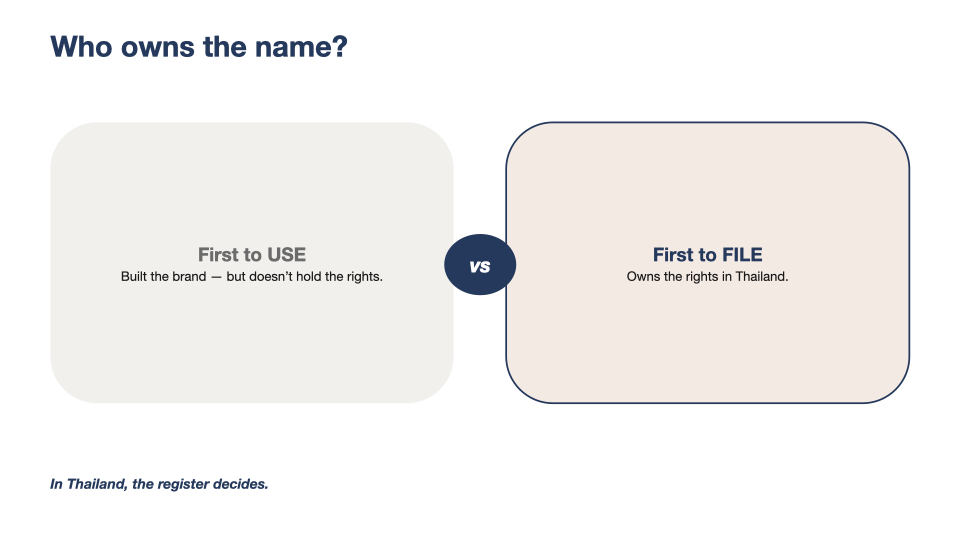
You picked the name. You paid for the logo. Customers know you by it. But in Thailand, using a name and owning it are two different things, and the gap between them is where good brands lose the thing they built.
This is a plain-English guide to fixing that: what a trademark search really tells you, what registration actually protects, how long it takes, and how to know if your name is free before you spend another baht on it.
Not sure the name is really yours? Let’s find out. Send us your brand name or logo and what you sell, and a Thai-licensed lawyer will tell you where it stands — and what it takes to lock it down.
First-to-file: the rule most Thai founders learn the hard way
Here’s the part that catches people out. Thailand is a first-to-file country. Under the Trademark Act B.E. 2534 (1991), protection generally goes to whoever files the mark first, not whoever used it first. You can trade under a name for three years, build a following, and still watch someone else register it and ask you to stop.
It happens quietly. A supplier, a former partner, a competitor who noticed your traction files your name while you were busy running the business. Now the options are all bad ones: rebrand everything you’ve printed, negotiate to buy back your own name, or fight it. Each of those costs far more than getting in first ever would have.
The good news: the fix is cheap and boring. Check the name is free, then file it. Done early, it’s insurance. Done late, it’s litigation.
One caveat worth knowing: first-to-file isn’t a shield for bad faith. Thailand has been a member of the Paris Convention for the Protection of Industrial Property since 2008 (accession 2 May 2008; in force 2 August 2008), which commits it to protecting well-known marks and acting against bad-faith copying, reinforced in Thai law by the well-known-mark ground (§8(10)) and the court’s power to cancel a wrongly-held registration on a better-right claim (§67). And the courts are using it: in a 2026 decision reported by Thai media, the coffee chain Luckin Coffee defeated a local company that had registered its name and logo, winning cancellation of those registrations, an order to stop using the mark, and damages (reported at over 95 million baht), with the ruling expressly treating bad-faith registration as a ground. The catch is in the fine print: that was a multi-year court battle won by a globally recognised brand. Proving bad faith or fame is slow, costly, and uncertain for everyone else, which is exactly why filing first, so you never have to, stays the cheap option. It is also why the best-run brands file long before they need to: HYROX registered its name about a month before it ran its first race.
Send us your mark before you build on it
Before you invest in packaging, signage, or a rebrand, it’s worth knowing whether the name is even yours to own. So skip the guesswork: send us the name or logo and what you sell, and a Thai-licensed lawyer will come back to you — what a proper clearance would need to check for your mark, the classes you’d likely file in, and what getting it registered first actually involves. From there, the search and the filing are the work a lawyer signs.
Email us your mark. Tell us the name and what you sell, and we’ll come back with what protecting it takes.
Search vs filing: why searching first is the cheap insurance
Two different jobs, and people skip the first one to save a little now:
- A trademark search (clearance) looks before you commit, to answer “is this name actually available and protectable?”
- A trademark filing is the application itself, lodged at the DIP (Department of Intellectual Property).
Filing without searching, in a first-to-file country, is how businesses pay for an application that gets refused, or that sails through and then draws a conflict from an earlier owner. The search is the small spend that stops the big one.
Two reports, and a quick screen
Not every business needs the same depth. It comes down to which question you’re actually asking:
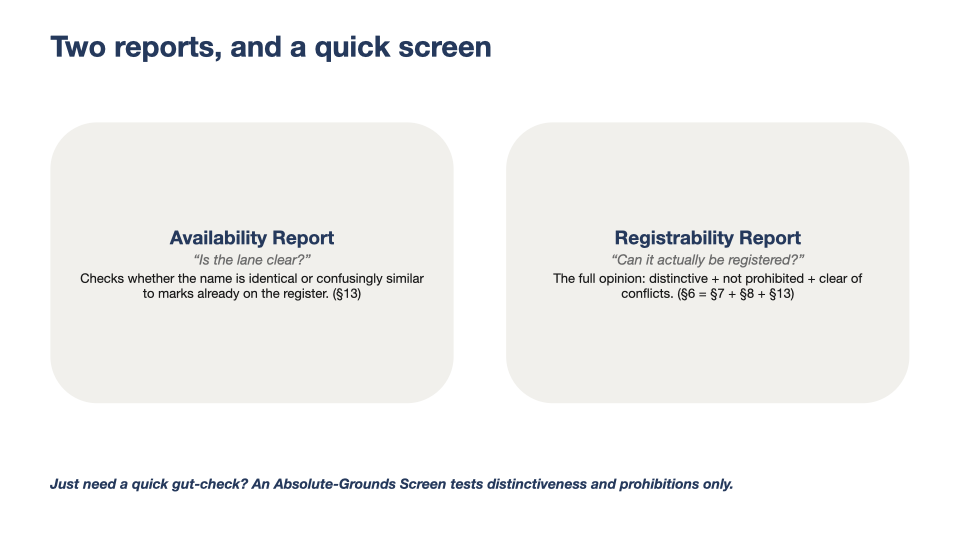
- “Is the lane clear?” → an Availability Report. This is the conflict search: is your mark identical or confusingly similar to an earlier registered, pending, or well-known mark (§13)? It’s the lighter, search-only product, and for most SMEs picking a name, it’s the first thing to run.
- “Can it actually be registered?” → a Registrability Report. The full opinion under §6: is the mark distinctive (§7), not prohibited (§8), and clear of conflicts (§13)? A mark can look free and still be refused for being too descriptive. This is the report that answers the whole question.
- Just want a quick gut-check on whether the name is even the kind of thing that can be a trademark, before you search? That’s an Absolute-Grounds Screen (distinctiveness and prohibited-marks only). Useful early, but on its own it is not clearance to file, because it hasn’t checked for conflicts.
The honest rule: a clear search is not the same as a registrable mark, and a registrable-looking name is not cleared until it’s been searched. We match the report to the moment you’re in.
How long registration takes in Thailand
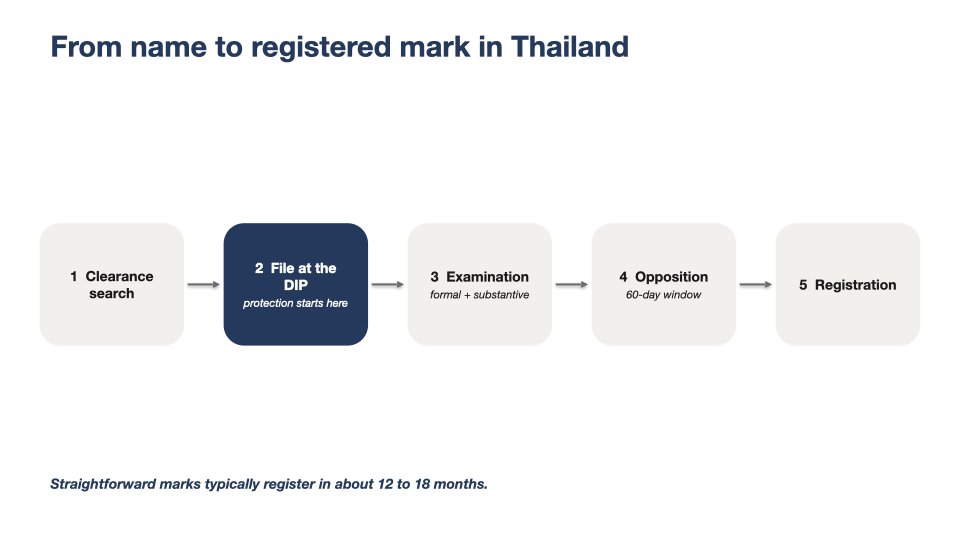
Roughly, the path runs: clearance search → file at the DIP → formal and substantive examination → published for opposition (a 60-day window) → registration. In straightforward cases that’s typically around 12 to 18 months. Two things worth knowing:
- Your protection priority starts from the filing date, not the registration date. That’s the whole argument for filing sooner rather than waiting until you “have time.”
- The DIP fee is paid separately from lodging the application. Miss the fee deadline and the application can be treated as abandoned. We track that so it doesn’t lapse on a technicality.
Growing beyond Thailand later? Meet the Madrid System
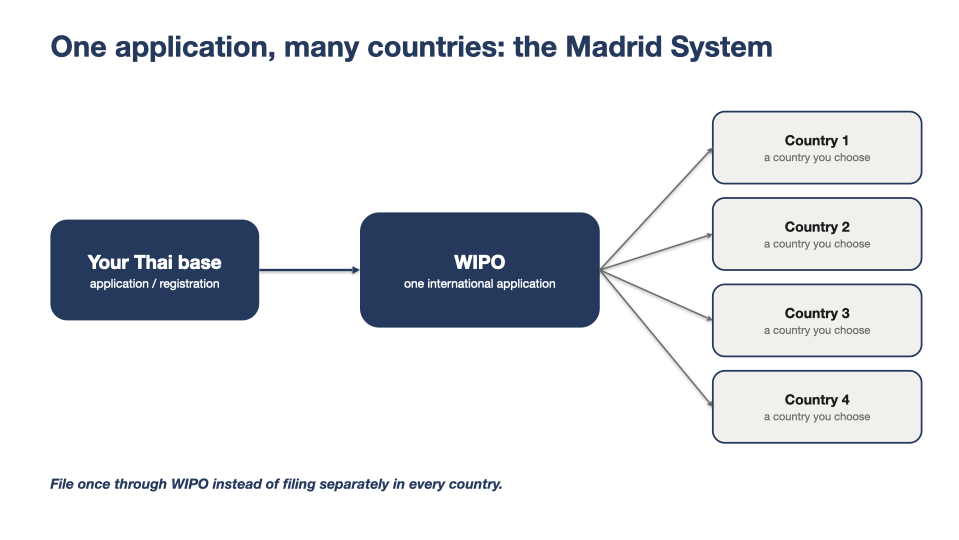
If you ever plan to sell abroad, you don’t have to file separately in every country. Thailand is a member of the Madrid Protocol (since November 2017). That means one international application, filed through WIPO and based on your home Thai application or registration, can designate the other member countries you care about. And under the Paris Convention’s 6-month priority, a foreign filing made within six months of your Thai filing can claim that original date. You don’t need this on day one, but it’s the reason getting your Thai filing right first pays off later — here’s how the Madrid System works in depth. And as your brand grows a family — sub-brands, new product lines, new classes — protecting all of it becomes portfolio work in its own right.
What we deliver
No parts list, just the destinations:
- Know if your name is yours before you build on it — the clearance search, done properly, by a lawyer, not a lookup.
- Get it filed and registered at the DIP, specifications and classes handled, fee deadlines tracked so nothing lapses.
Not sure whether you need a quick search or the full opinion? Send me the name and I’ll tell you.
Who’s behind this
CorpJurist is a licensed Thai law firm. Your trademark work, the clearance search, the opinion, the filing, is handled and signed by a Thai-licensed lawyer with 14 years of practice, and you deal with that lawyer directly, in English or Thai. The clearance and the filing are legal work a lawyer is accountable for, start to finish.
Plans
Straightforward packages, scoped to what you actually need:
- Availability Search — is the lane clear before you commit.
- Registrability Opinion — the full §6 answer: distinctive, not prohibited, clear of conflicts.
- File & Register — end-to-end filing at the DIP with fee-deadline tracking.
Every package is fixed-scope with transparent inclusions and no lock-in. Request a quote and we’ll size it to your marks and classes.
Questions founders actually ask
“I’ve used the name for years. Doesn’t that protect me?” Not the way you’d hope. Thailand rewards the first to file. Long use can help in some disputes, but it’s a weaker, costlier position than simply owning the registration.
“Can’t I just search it myself online?” You can look up the register yourself, and it’s a fair first move. But a DIY search finds the obvious identical hits, not the confusingly-similar ones, the descriptiveness problem, or the pending applications that haven’t published yet, and that gap is exactly where refusals come from. Reading those calls is the judgment you’re paying a lawyer for — send us the name and we’ll tell you what it needs.
“Is a logo different from the name?” They can be filed as different marks, and often both matter. We’ll tell you which to protect first based on what actually carries your brand.
“What if the name isn’t available?” Better to learn that now, for the price of a search, than after you’ve printed 5,000 boxes. If it’s blocked, we’ll tell you how blocked, and whether a tweak clears it.
Own your name
The cheapest day to protect your brand was the day you launched it. The second cheapest is today.
Send me the name and what you sell, and if it’s a keeper, let’s file it before someone else does.
We’ll use the details you submit only to respond to your enquiry (PDPA B.E. 2562 (2019): notice, consent, lawful basis). This page is general information, not a legal opinion.
Send us your mark
Tell us your brand and what you sell, and a CorpJurist lawyer will come back to you on what protecting it takes.
Thanks — we've got it. A CorpJurist lawyer will get back to you about your mark.