You've got new products, new markets, and one messy folder of trademarks. Time to fix that.
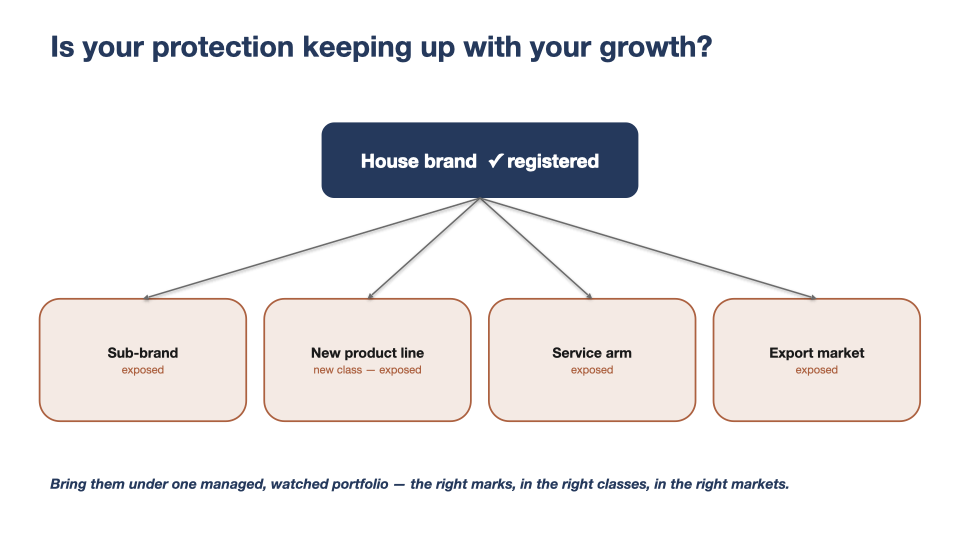
When you were one product in one market, protecting the brand was simple: file the name, done. But you grew. Now there’s a parent brand, a couple of sub-brands, a product line you launched last quarter, and a market or two abroad you’re eyeing. Somewhere in there, your trademark protection stopped keeping pace, and you’re not entirely sure what’s covered and what’s exposed.
This is a plain-English guide to running trademarks like a portfolio instead of a pile: filing across the right classes, protecting the sub-brands that carry real value, watching the register so you catch a copycat early, and knowing when the full opinion is worth it. The destination is simple: protection that grows at the speed you do.
Not sure what’s protected and what’s exposed? Ask us. Send us your brand list — parent, sub-brands, product lines — and a Thai-licensed lawyer will tell you where the gaps are and what closing them takes.
The gap that opens up when you grow faster than your filings
Here’s how it usually goes. You registered your main brand years ago, in the one class that fit the business back then. Since then you’ve added a product line, a service arm, maybe a mobile app, and a sub-brand or two with names of their own. Each of those is a thing a trademark is supposed to cover, and quietly, most of them aren’t covered at all.
Thailand is a first-to-file country under the Trademark Act B.E. 2534 (1991) (as amended). Protection generally goes to whoever files first, in the specific classes they file for. So the exposure isn’t hypothetical. Your registration in one class doesn’t stretch to a new class you’ve since expanded into (the counter-example worth studying is a brand that claimed its classes years before it used them). Your parent brand being registered doesn’t protect a sub-brand nobody filed. And the market you’re about to enter? Your Thai registration stops at the border.
Let that gap sit and the costs stack up in ways that hurt more at your size than they would have at the start. A competitor files in the class you left open and boxes you out of your own product line. Someone registers your sub-brand and you either buy it back or rebrand a product that’s already on shelves. You go to expand abroad and discover the name’s been taken in your target market. At scale, a rebrand isn’t a new sign on the door. It’s packaging, listings, distributor contracts, app-store entries, and every customer who knew you by the old name.
The fix isn’t dramatic. It’s a portfolio you can actually see: the right marks, in the right classes, in the right markets, watched so you spot trouble while it’s still cheap to stop.
One caveat worth knowing: first-to-file isn’t a shield for bad faith. Thailand has been a member of the Paris Convention for the Protection of Industrial Property since 2008 (accession 2 May 2008; in force 2 August 2008), which commits it to protecting well-known marks and acting against bad-faith copying, reinforced in Thai law by the well-known-mark ground (§8(10)) and the court’s power to cancel a wrongly-held registration on a better-right claim (§67). And the courts are using it: in a 2026 decision reported by Thai media, the coffee chain Luckin Coffee defeated a local company that had registered its name and logo, winning cancellation of those registrations, an order to stop using the mark, and damages (reported at over 95 million baht), with the ruling expressly treating bad-faith registration as a ground. It’s a real backstop, but a costly one: a multi-year court battle won by a globally recognised brand. Across a growing portfolio, the cheaper play is to file each mark first so you never have to prove bad faith at all.
Send us your brand list, and we’ll find the gaps
Before the next product launch, it’s worth knowing what’s actually covered and what’s sitting exposed across your marks. Send us your brand list — parent brand, sub-brands, product lines, the markets you’re in — and a Thai-licensed lawyer will come back to you: which names are protected, which classes you’ve grown into without filing, and which sub-brands are worth their own registration. From there, the searches, filings, and the watch are the work a lawyer signs.
Email us your brand list. We’ll tell you where the gaps are and what closing them takes.
Search vs filing: why searching first is the cheap insurance (and cheaper at scale)
Two different jobs, and the temptation to skip the first one only grows as you file more:
- A trademark search (clearance) looks before you commit, to answer “is this name actually available and protectable, in the classes I need?”
- A trademark filing is the application itself, lodged at the DIP (Department of Intellectual Property).
Filing without searching, in a first-to-file country, is how businesses pay for applications that get refused, or that sail through and then draw a conflict from an earlier owner. When you’re filing one mark, that’s a small risk. When you’re filing a family of them across several classes, the odds that at least one collides go up, not down. The search is the small spend that stops the big one, and it’s the spend that keeps a growing portfolio clean instead of accumulating quiet problems.
Filing across classes: covering the business you have now, not the one you started with
Trademarks are registered against classes of goods and services. Your protection lives inside the classes you filed for. So the practical question for a scaling business isn’t just “is my name registered?” It’s “is it registered everywhere my business now operates?”
If you started in one class and have since added product lines or service arms, there are almost certainly classes you’ve grown into without filing. Since the 2016 amendment (Trademark Act No. 3 B.E. 2559 (2016)), Thailand allows multi-class applications, so you can cover several classes in a single filing rather than running separate ones. Getting the class coverage right, wide enough to protect where you actually trade and where you’re about to, without paying to register in classes you’ll never touch, is exactly the judgment a portfolio review is for. Some sectors feel this hardest — a food or drink brand can straddle packaged-goods and restaurant classes at the same time.
Protecting the sub-brands, not just the parent
A registered parent brand doesn’t automatically protect a differently-named sub-brand, product line, or feature. If a sub-brand carries real weight, the name customers actually ask for, the label that sells the product, it usually deserves its own protection rather than riding on the house mark.
The move isn’t to file everything. It’s to triage: which names carry brand value worth protecting, which are throwaway product descriptors, and which sit somewhere in between. A good portfolio protects the marks that matter and doesn’t waste spend on the ones that don’t. We’ll help you draw that line.
Two reports, and a quick screen (and why the full opinion earns its keep as you grow)
Not every mark needs the same depth. It comes down to which question you’re actually asking:
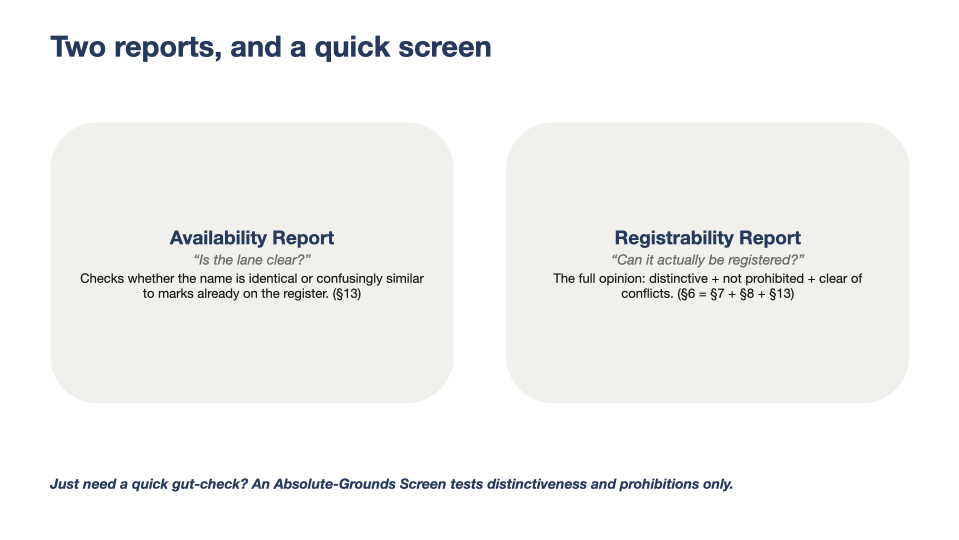
- “Is the lane clear?” → an Availability Report. This is the conflict search: is your mark identical or confusingly similar to an earlier registered, pending, or well-known mark (§13)? It’s the lighter, search-only product, and it’s a sensible first pass on a new name.
- “Can it actually be registered?” → a Registrability Report. The full opinion under §6: is the mark distinctive (§7), not prohibited (§8), and clear of conflicts (§13)? A mark can look free and still be refused for being too descriptive, and that risk climbs the more product-descriptive names you file.
- Just want a quick gut-check on whether a name is even the kind of thing that can be a trademark, before you search? That’s an Absolute-Grounds Screen (distinctiveness and prohibited-marks only). Useful early, but on its own it is not clearance to file, because it hasn’t checked for conflicts.
Here’s why the full Registrability Report matters more the bigger your portfolio gets. When you file one mark, a refusal is an annoyance. When you’re filing across product lines on a schedule, refusals and conflicts are budget and calendar risk you can’t see coming. The full opinion tells you, before you spend, whether each mark is distinctive enough to survive examination and clear of the conflicts that trigger a fight. Across a portfolio, that’s the difference between filings that land and filings that stall. The honest rule holds: a clear search is not the same as a registrable mark, and a registrable-looking name is not cleared until it’s been searched. We match the report to the mark and the moment.
Watching the register: catching a copycat while it’s still cheap to stop
Filing protects the marks you own. It doesn’t tell you when someone files something that steps on them. That’s what a trademark watch is for: monitoring new applications at the DIP and flagging marks that look confusingly similar to yours, so you can act inside the window that matters.
Why it counts for a scaling brand: the more recognisable you get, the more attractive your names become to copy, and Thai registration runs on a 60-day opposition window after a mark is published. Miss that window and your cheapest, cleanest route to stopping a conflicting mark closes, leaving slower and costlier options. Watching turns “we found out when their product hit the shelf” into “we caught it at publication and opposed it.” For a portfolio worth protecting, that early warning is the point.
How long registration takes in Thailand
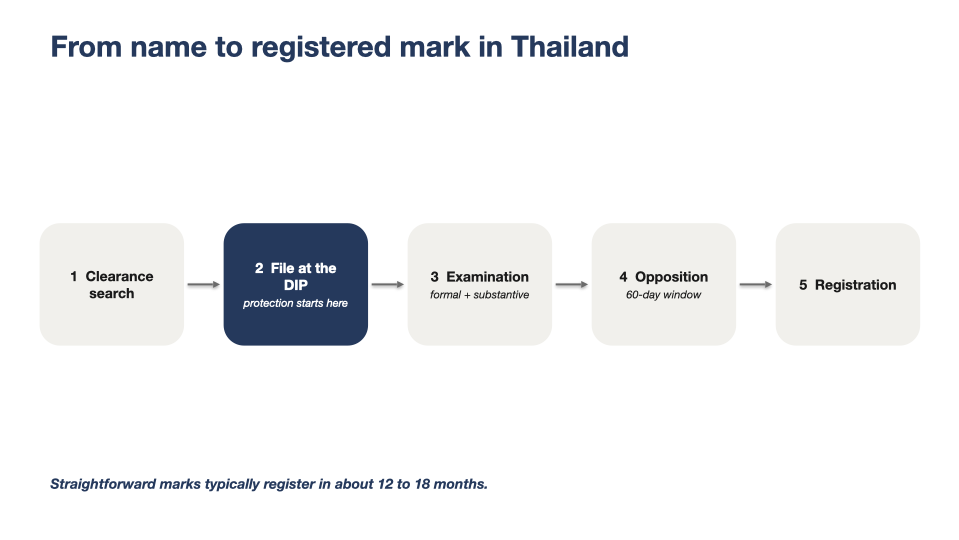
Roughly, the path runs: clearance search → file at the DIP → formal and substantive examination → published for opposition (a 60-day window) → registration. In straightforward cases that’s typically around 12 to 18 months. Two things worth knowing when you’re filing several marks:
- Your protection priority starts from the filing date, not the registration date. Across a portfolio, that’s the argument for filing each new mark as soon as the name is locked, rather than batching them “when there’s time.”
- The DIP fee is paid separately from lodging the application. Miss the fee deadline and the application can be treated as abandoned. When you’re tracking many marks at once, that’s exactly the kind of technicality that lapses quietly. We track it so none of yours do.
Growing beyond Thailand? The Madrid System keeps the portfolio manageable
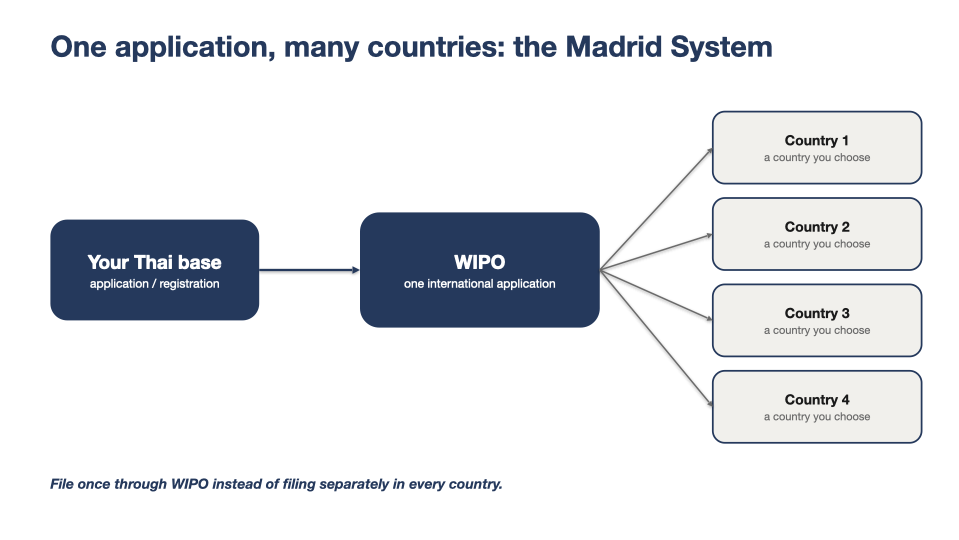
When you expand into new markets, you don’t have to run a separate filing in every country. Thailand is a member of the Madrid Protocol (since November 2017). That means one international application, filed through WIPO and based on your home Thai application or registration, can designate the other member countries you’re moving into, and you manage that international registration from one place instead of juggling separate national files. Under the Paris Convention’s 6-month priority, a foreign filing made within six months of your Thai filing can also claim that original date.
Two things a scaling operator should know. Madrid gives you central management, one registration to renew and extend as you enter more markets, which is a real relief once the portfolio spans borders. But for roughly the first five years, the international registration stays tied to your home mark, so if the base filing falls over, the international one can too. Which is one more reason to get the Thai foundation right before you build the international portfolio on top of it. (We break down how the Madrid System actually works in a separate guide.)
What we deliver
No parts list, just the destinations:
- See the whole portfolio — a clear picture of what’s registered, in which classes, and where the gaps are between your filings and the business you actually run today.
- File the right marks in the right classes — parent brand and the sub-brands worth protecting, class coverage matched to where you trade and where you’re headed, filed and tracked at the DIP so nothing lapses.
- Watch the register — monitoring for confusingly similar filings so you catch a conflict at publication, not at launch.
- Grow abroad without refiling everywhere — Madrid designations planned around your expansion, managed from one place.
Not sure what’s covered and what’s exposed across your marks? Send me your brand list and I’ll tell you where the gaps are.
Who’s behind this
CorpJurist is a licensed Thai law firm. Your trademark work, the clearance search, the opinion, the filing, the portfolio review, is handled and signed by a Thai-licensed lawyer with 14 years of practice, and you deal with that lawyer directly, in English or Thai. The clearance, the opinion, and the portfolio strategy are legal work a lawyer is accountable for, start to finish.
Plans
Straightforward packages, scoped to a portfolio rather than a single mark:
- Portfolio Review — a map of what’s registered, where the class gaps are, and which sub-brands are exposed.
- Availability Search — is the lane clear before you launch a new product or sub-brand.
- Registrability Opinion — the full §6 answer for the marks that matter: distinctive, not prohibited, clear of conflicts.
- File & Register — multi-class filing at the DIP with fee-deadline tracking.
- Trademark Watch — ongoing monitoring so you catch conflicting filings inside the window.
Every package is fixed-scope with transparent inclusions and no lock-in. Request a quote and we’ll size it to your marks, classes, and markets.
Questions growing brands actually ask
“My main brand is registered. Aren’t the sub-brands covered too?” Not automatically. A registration protects the mark you filed, in the classes you filed it for. A differently-named sub-brand or a product line in a new class usually needs its own protection. That’s the most common gap we find in a growing portfolio.
“Do I really need to file in more than one class?” Only in the classes where you actually trade or plan to. But if you’ve expanded since your first filing, there’s a good chance you’ve grown into classes you never covered. A portfolio review tells you which gaps are real and worth closing.
“What’s a trademark watch, and do I need one?” It’s ongoing monitoring of new filings at the DIP, flagging marks that look confusingly similar to yours so you can oppose inside the window. The more recognisable your brand, the more it’s worth having. It turns catching a copycat from luck into process.
“Can’t I just search each new name myself online?” You can, as a first move. But a DIY search finds the obvious identical hits, not the confusingly-similar ones, the descriptiveness problem, or the pending applications that haven’t published yet. Across a portfolio, those are exactly the gaps that turn into refusals and disputes — and reading them is the judgment you’re paying a lawyer for.
“We’re expanding into a couple of new countries. Where do we start?” With your Thai foundation and a plan. Getting the home filing right first is what lets the Madrid route work smoothly when you designate new markets. Send us the markets you’re entering and we’ll map the sequence.
Protection that keeps pace with growth
The messy-folder stage is normal. It’s what happens when a brand grows faster than its paperwork. The fix is to stop treating trademarks one at a time and start running them as a portfolio, before the next launch or the next market makes a small gap an expensive one.
Send me your brand list, and we’ll map what’s protected and what’s exposed across your marks.
We’ll use the details you submit only to respond to your enquiry (PDPA B.E. 2562 (2019): notice, consent, lawful basis). This page is general information, not a legal opinion.
Send us your mark
Tell us your brand and what you sell, and a CorpJurist lawyer will come back to you on what protecting it takes.
Thanks — we've got it. A CorpJurist lawyer will get back to you about your mark.