Your recipe is protected. Your brand isn't. And the brand is what sells the jar.
You spent months on the flavour. You got the FDA approval. The packaging looks great on the shelf and better on Shopee. But here’s the gap most food and drink founders never see coming: in Thailand, the licence that lets you sell the product and the registration that lets you own the brand are two completely different things, run by two different ministries. Get the first and skip the second, and the name customers reach for can still be filed out from under you.
This is a plain-English guide to closing that gap: what a trademark actually protects on a food or drink brand, which classes you need, how your packaging fits in, and how to check your name is free before you print another label.
Not sure the name is really yours? Let’s find out. Send us your brand name or logo and what you sell, and a Thai-licensed lawyer will tell you where it stands — and what it takes to lock it down.
The FDA number that fooled you into feeling safe
Most F&B founders we meet believe they’re covered because they cleared the hard part. They have their อย. (FDA) registration under the Food Act B.E. 2522 (1979), the manufacturing is compliant, the label ticks every box. So the brand must be locked too, right?
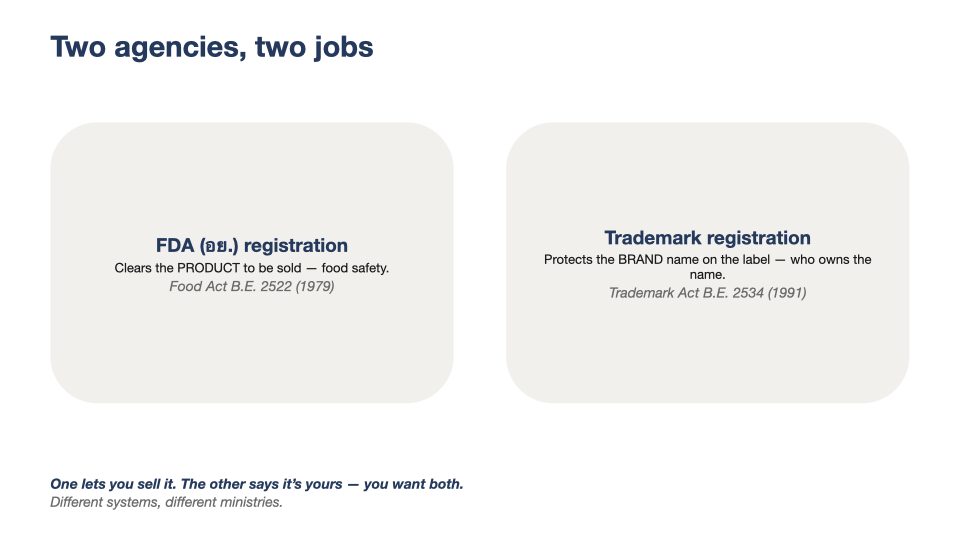
It isn’t, and the two are not even related. An FDA registration certifies that your product is safe and legal to sell. A trademark protects the name and look that make customers pick your product over the one beside it. One is food safety. The other is brand ownership. Passing the first tells you nothing about the second.
Now play it forward. Thailand is a first-to-file country under the Trademark Act B.E. 2534 (1991). Protection generally goes to whoever files the mark first, not whoever used it first. So the contract manufacturer who packs your sauce, the distributor who lists you on Lazada, the ex-partner who knows your roadmap, any of them can register your name while you’re focused on the next production run. When they do, the bill is brutal in F&B specifically: relabel every SKU, rebrand the storefront, pull and re-shoot the marketplace listings, reprint cartons you’ve already paid for, and explain to your stockists why the name changed. A rebrand for a services firm is a headache. For a food brand, it’s the whole shelf.
The fix is cheap and boring, which is the best kind. Check the name is free, then file it in the right classes. Done early, it’s insurance. Done after someone else files, it’s a negotiation you’re losing.
One caveat worth knowing: first-to-file isn’t a shield for bad faith. Thailand has been a member of the Paris Convention for the Protection of Industrial Property since 2008 (accession 2 May 2008; in force 2 August 2008), which commits it to protecting well-known marks and acting against bad-faith copying, reinforced in Thai law by the well-known-mark ground (§8(10)) and the court’s power to cancel a wrongly-held registration on a better-right claim (§67). And the courts are using it: in a 2026 decision reported by Thai media, the coffee chain Luckin Coffee defeated a local company that had registered its name and logo, winning cancellation of those registrations, an order to stop using the mark, and damages (reported at over 95 million baht), with the ruling expressly treating bad-faith registration as a ground. The catch is in the fine print: that was a multi-year court battle won by a globally recognised brand. Proving bad faith or fame is slow, costly, and uncertain for everyone else, which is exactly why filing first, so you never have to, stays the cheap option.
Send us your mark before you print a label
Before you commit to that packaging run or that marketplace launch, it’s worth knowing whether the name is even yours to own — especially with the descriptiveness traps that catch food brands. Send us the name or logo and what you sell, and a Thai-licensed lawyer will come back to you: whether the name clears the distinctiveness bar, which classes your product line needs, and how to protect the packaging too. From there, the search and the filing are the work a lawyer signs.
Email us your mark. Tell us the name and what you sell, and we’ll come back with what protecting it takes.
FDA approval vs trademark: the one distinction that saves food brands
This is the block to read twice, because it’s where the money leaks.
- Your FDA registration (อย.) clears the product. It says the food or drink is safe, correctly labelled, and legal to sell in Thailand, under the Food Act B.E. 2522 (1979), administered by the FDA (Ministry of Public Health).
- Your trademark protects the brand. It gives you the exclusive right to the name and mark on that product, under the Trademark Act B.E. 2534 (1991), administered by the DIP (Department of Intellectual Property) (Ministry of Commerce).
An อย. number proves your food won’t hurt anyone. It says nothing about who owns the name, because the two live in different ministries and, frankly, don’t talk much. You can hold a perfect FDA registration and still not own your own brand. Plenty of founders find that out the day a cease-and-desist arrives from someone who filed the name they’ve been selling under for two years.
The way to hold it in your head: the FDA licence is the permit that lets the product onto the shelf. The trademark is the deed to the name on the label. One clears the food to be sold; the other says the brand is yours. You want both.
Search vs filing: why searching first is the cheap insurance
Two different jobs, and food founders skip the first to save a little now:
- A trademark search (clearance) looks before you commit, to answer “is this name actually available and protectable for what I sell?”
- A trademark filing is the application itself, lodged at the DIP.
Filing without searching, in a first-to-file country, is how a brand pays for an application that gets refused, or that sails through and then draws a conflict from an earlier owner in the same aisle. In food and drink the risk is sharper, because so many brands crowd into the same few classes and reach for the same words: “farm”, “gold”, “fresh”, “organic”, a fruit name on its own. Words like those are often too descriptive to protect, or sit close to a mark someone already owns. The search is the small spend that stops the big one.
Two reports, and a quick screen
Not every brand needs the same depth. It comes down to which question you’re actually asking:
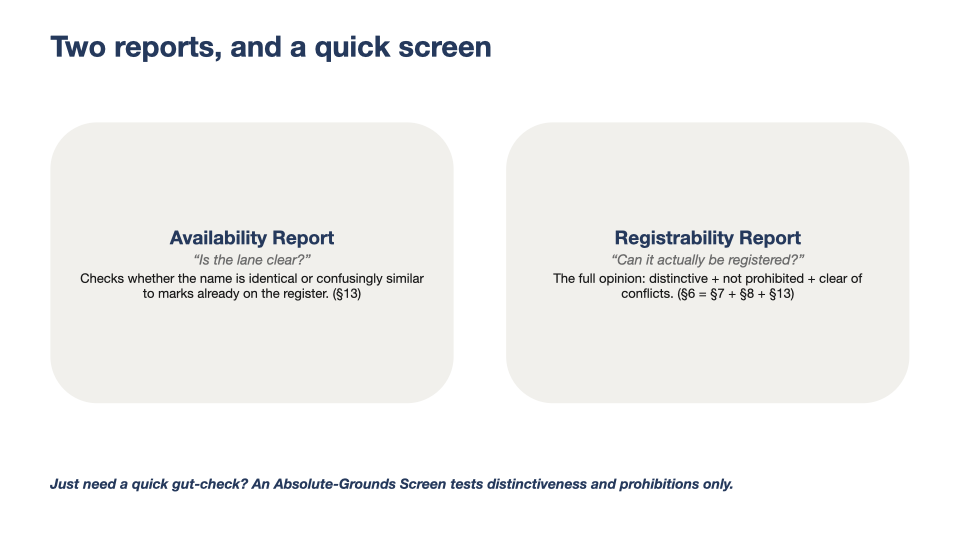
- “Is the lane clear?” → an Availability Report. This is the conflict search: is your mark identical or confusingly similar to an earlier registered, pending, or well-known mark (§13)? It’s the lighter, search-only product, and for most food brands naming a product, it’s the first thing to run.
- “Can it actually be registered?” → a Registrability Report. The full opinion under §6: is the mark distinctive (§7), not prohibited (§8), and clear of conflicts (§13)? A tasty name can still be refused for being too descriptive of the food itself. This is the report that answers the whole question.
- Just want a quick gut-check on whether the name is even the kind of thing that can be a trademark, before you search? That’s an Absolute-Grounds Screen (distinctiveness and prohibited-marks only). Useful early, but on its own it is not clearance to file, because it hasn’t checked for conflicts.
The honest rule: a clear search is not the same as a registrable mark, and a registrable-looking name is not cleared until it’s been searched. We match the report to the moment you’re in.
The names that get food brands refused
Before you fall for a name, know the three that trip up food and drink brands most often. Two are about distinctiveness under §7 of the Trademark Act B.E. 2534 (1991): a mark has to actually distinguish your goods, so a name that only describes them isn’t registrable on its own.
- Naming the brand after the dish or the menu item. Call a chili-paste brand simply “Shrimp Chilli Paste,” or a granola “Healthy Granola,” and you’ve described the product itself. Under §7 a word that is directly descriptive of the character of the goods isn’t distinctive, so it’s refused, or at best registers weak and easy to copy around.
- Building the name out of quality or laudatory words. “Premium,” “Gold,” “Best,” “Original,” “Quality,” “Fresh,” “Organic” say how good the product is, not whose it is. §7 treats words directly descriptive of the quality of the goods as non-distinctive, so a name that leans on them usually won’t clear on its own. (A descriptive name can sometimes be saved if it has become genuinely well known through long use, but that’s a hard, evidence-heavy road, not a plan.)
- Using a vulgar or offensive word. A mark contrary to public order or good morals is flatly barred from registration under §8(9) — no distinctiveness argument rescues it. A cheeky name that crosses the line simply cannot be registered. And this isn’t a Thai quirk: most trademark systems refuse both descriptive and immoral marks (the Paris Convention framework builds in both bars), so a name that fails here tends to fail abroad too.
The move is to build the brand around something distinctive — an invented or coined word, an arbitrary word that has nothing to do with food, or a distinctive logo — and keep the descriptive words for your packaging copy, not your trademark. We’ll tell you, before you print anything, which parts of your name are protectable and which are only describing lunch.
The classes a food and drink brand actually needs
Here’s where F&B gets its own rules. A trademark is only protected for the goods and services you register it against, sorted into Nice classes. Food and drink spreads across several, and picking one when you needed three is how brands leave the back door open. The ones that matter most:
- Class 29 — the packaged-food staples: meat, fish, poultry, dairy and cheese, eggs, edible oils, jams, and preserved, frozen, dried, or cooked fruit and vegetables. (Your cold-pressed oil, frozen dumplings, yoghurt, dried mango.)
- Class 30 — the pantry: coffee, tea, cocoa, rice, flour, bread, pastry, confectionery, chocolate, noodles, sauces, spices, and condiments. (Your chili paste, granola, instant noodles, snack bars.)
- Class 31 — fresh and raw: fresh fruit and vegetables, live plants and animals, unprocessed grains. (Your fresh fruit for export, specialty rice sold as raw grain.)
- Class 32 — soft drinks and beer: mineral and aerated waters, soft drinks, fruit juices, and beers.
- Class 33 — the alcohol: wine, spirits, and other alcoholic beverages except beer.
- Class 43 — the service side: restaurants, cafés, bars, and catering. If you run the venue and sell the product, this is a separate class from your packaged goods.
The trap is real and common. A café brand (Class 43) that also bottles its own cold brew (Class 30 or 32) and sells a retail sauce line (Class 30) is three fronts, not one. File only the café and your bottled products are unprotected, free for anyone to register. We map your actual and planned product lines to the classes before filing, so you’re not paying to protect a fraction of your own brand.
Your packaging is part of the brand. Here’s how you protect it.
In Thailand there’s no single “trade dress” registration the way some countries have. You protect the look of your product by registering the pieces that make it recognisable, each as a mark. Under §4 of the Trademark Act B.E. 2534 (1991), a “mark” can be a name, a word, an invented device or logo, a combination of colours, and even the shape or configuration of an object. So the label artwork, the logo, a signature colour combination, and in some cases a distinctive bottle or jar shape can each be filed and owned. That’s how you stop a copycat from selling a near-identical-looking product under a slightly different name. We’ll tell you which elements are worth registering and which won’t clear.
How long registration takes in Thailand
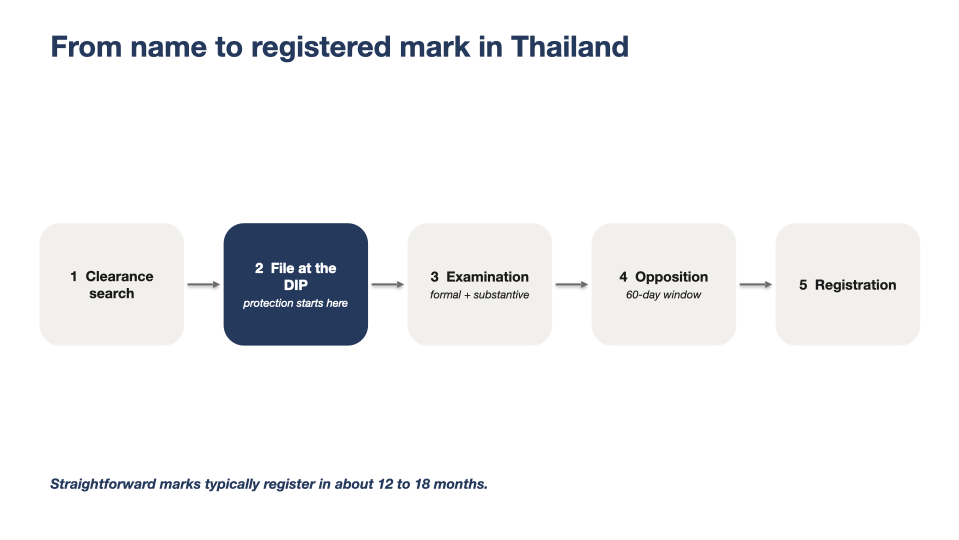
Roughly, the path runs: clearance search → file at the DIP → formal and substantive examination → published for opposition (a 60-day window) → registration. In straightforward cases that’s typically around 12 to 18 months. Two things worth knowing:
- Your protection priority starts from the filing date, not the registration date. That’s the whole argument for filing before your product hits the shelf, not after it takes off and gets noticed.
- The DIP fee is paid separately from lodging the application. Miss the fee deadline and the application can be treated as abandoned. We track that so a whole filing doesn’t lapse on a technicality.
Selling abroad later? Meet the Madrid System
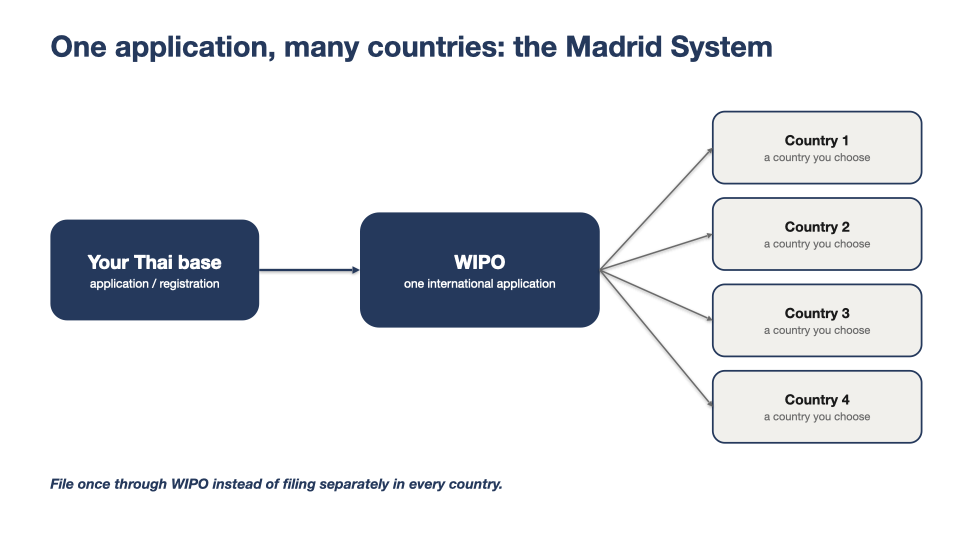
Thai food and drink travels. If you plan to put your sauce, snack, or drink in front of buyers overseas, you don’t have to file separately in every country. Thailand is a member of the Madrid Protocol (since November 2017). One international application, filed through WIPO and based on your home Thai application or registration, can designate the other member countries you care about. And under the Paris Convention’s 6-month priority, a foreign filing made within six months of your Thai filing can claim that original date. You don’t need this on day one, but it’s the reason getting the Thai filing right first pays off when a distributor in another market comes knocking. (Here’s how the Madrid System works, in depth.)
What we deliver
No parts list, just the destinations:
- Know if your name is yours before you print labels or launch on a marketplace — the clearance search, done properly, by a lawyer, not a lookup.
- Filed in the right classes, packaging elements and product lines mapped so you’re protecting the whole brand, not one corner of it, with fee deadlines tracked so nothing lapses.
Not sure which classes your product line needs, or whether a quick search or the full opinion is right? Send me the name and what you sell, and I’ll tell you.
Who’s behind this
CorpJurist is a licensed Thai law firm. Your trademark work, the clearance search, the opinion, the filing, is handled and signed by a Thai-licensed lawyer with 14 years of practice, and you deal with that lawyer directly, in English or Thai. The clearance and the filing are legal work a lawyer is accountable for, start to finish.
Plans
Straightforward packages, scoped to what you actually sell:
- Availability Search — is the lane clear before you commit to packaging.
- Registrability Opinion — the full §6 answer: distinctive, not prohibited, clear of conflicts.
- File & Register — end-to-end filing at the DIP across the classes your product line needs, with fee-deadline tracking.
Every package is fixed-scope with transparent inclusions and no lock-in. Request a quote and we’ll size it to your marks, your packaging elements, and your classes.
Questions food founders actually ask
“I have my FDA approval. Isn’t my brand protected?” No, and this is the one that costs people. FDA (อย.) registration under the Food Act B.E. 2522 (1979) clears the product to be sold. It gives you no rights over the name. The brand is protected only by a trademark registration under the Trademark Act B.E. 2534 (1991). Two different systems, two different ministries.
“I’ve sold under this name for years. Doesn’t that count?” Not the way you’d hope. Thailand rewards the first to file. Long use can help in some disputes, but it’s a weaker, costlier position than simply owning the registration before a problem starts.
“Do I really need more than one class?” Often, yes. A brand that sells a packaged product and runs a café or catering service usually spans a goods class (say 29, 30, or 32) and the services class (43). Register one and the other stays open for someone else to take.
“Can I protect my packaging and bottle design, not just the name?” To a point. Thailand doesn’t register “trade dress” as one thing, but under §4 you can register the logo, the label device, a signature colour combination, and sometimes a distinctive shape, each as its own mark. We’ll tell you which of your elements will actually clear.
“Can’t I just search it myself online?” You can, as a first move. But a DIY search finds the obvious identical hits, not the confusingly-similar ones, the descriptiveness problem (a real risk with food words), or the pending applications that haven’t published yet. That gap is exactly where refusals come from — and reading those calls is the judgment you’re paying a lawyer for.
Lock the brand that sells the product
You cleared the food. Now own the name on it. In a first-to-file country, the cheapest day to protect your food brand was the day you named it. The second cheapest is today.
Send me the name and what you sell, and if it’s a keeper, let’s file it before someone else does.
We’ll use the details you submit only to respond to your enquiry (PDPA B.E. 2562 (2019): notice, consent, lawful basis). This page is general information, not a legal opinion.
Send us your mark
Tell us your brand and what you sell, and a CorpJurist lawyer will come back to you on what protecting it takes.
Thanks — we've got it. A CorpJurist lawyer will get back to you about your mark.