You sell into Thailand. Does the name actually belong to you here?
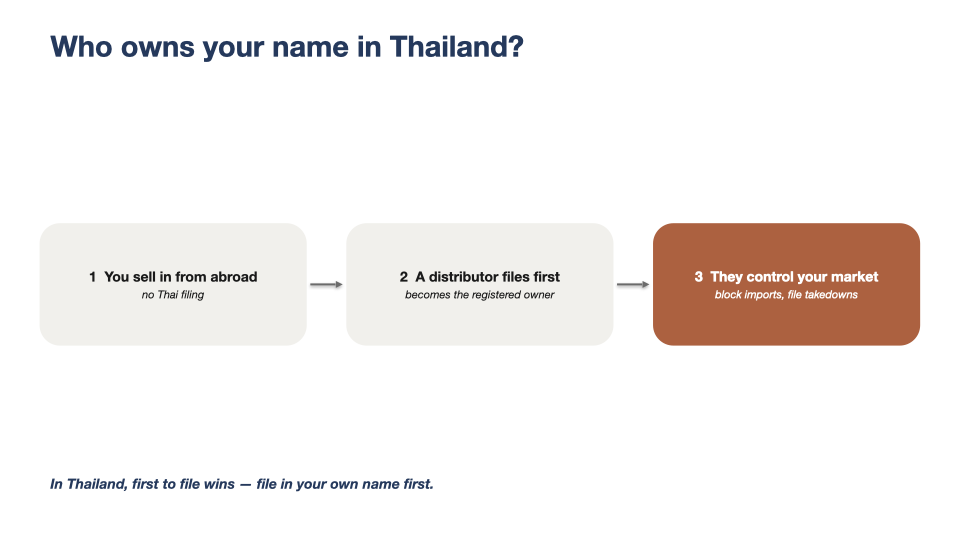
You ship into Thailand. Maybe through Lazada or Shopee, maybe through a distributor or an importer who knows the local market. Sales are growing. But you don’t have a company here, an office here, or a single piece of paper here that says the brand name is yours. And in Thailand, that gap is exactly where good brands get taken.
This is a plain-English guide for foreign sellers with no Thai entity: why owning your name here is a separate thing from selling here, the very real risk that a local partner registers it before you do, and how to lock the name down before your sales get big enough to be worth copying. (If you’re actually incorporating or opening an office here, that’s a different entry situation.)
Selling into Thailand? Find out if the name’s still yours to claim. Send us your brand name or logo and what you sell, and a Thai-licensed lawyer will tell you where it stands here — and how to file it in your own name.
First-to-file, from the outside looking in
Here’s the rule that catches foreign sellers off guard. Thailand is a first-to-file country. Under the Trademark Act B.E. 2534 (1991), the rights generally go to whoever files the mark in Thailand first, not to whoever built the brand or sold it first. Your registration back home does nothing here. Trademarks are territorial. As far as the Thai register is concerned, if you haven’t filed in Thailand, your name is unclaimed.
Now add the part that stings. The people best placed to notice your name is unclaimed are the people already helping you sell it: a distributor, an importer, a local agent, or an opportunist watching the marketplaces for foreign brands that are getting traction but haven’t filed. Any of them can register your mark in their own name. And once they hold the registration, they can turn it against you: block your imports, file takedowns against your own Lazada and Shopee listings, demand a fee to “assign it back,” or simply lock you out of the market you built. You go from brand owner to guest in your own name.
Can you get it back? Sometimes. Thai law gives a true owner a route to petition the court to cancel a mark someone else grabbed. But that’s a court case in a foreign country, on a clock, against someone who is now the registered owner. It is slow, uncertain, and costs many times more than filing first ever would have.
The fix is boring and cheap by comparison: file the name in Thailand, in your name, before you scale. Done early, it’s a form. Done late, it’s a lawsuit.
One caveat worth knowing: first-to-file isn’t a shield for bad faith. Thailand has been a member of the Paris Convention for the Protection of Industrial Property since 2008 (accession 2 May 2008; in force 2 August 2008), which commits it to protecting well-known marks and acting against bad-faith copying, reinforced in Thai law by the well-known-mark ground (§8(10)) and the better-right cancellation route (§67). And the courts are using it: in a 2026 decision reported by Thai media, the coffee chain Luckin Coffee defeated a local company that had registered its name and logo, winning cancellation of those registrations, an order to stop using the mark, and damages (reported at over 95 million baht), with the ruling expressly treating bad-faith registration as a ground. If a distributor or opportunist has already grabbed your name, that’s the door you’d go through, but read the fine print: it was a multi-year court battle won by a globally recognised brand. Proving bad faith or fame is slow, costly, and uncertain, which is exactly why filing first, so you never have to, stays the cheap option.
Send us your mark — and find out if a distributor already has it
Before you pour more into ads, listings, or a distributor push in Thailand, it’s worth knowing whether the name is still yours to claim here — or whether someone local has already filed it. Send us the name or logo and what you sell, and a Thai-licensed lawyer will come back to you: whether the name looks open to register, how to get it filed in your own name, and what your options are if a distributor or opportunist got there first. From there, the search and the filing are the work a lawyer signs.
Email us your mark. Tell us the name and what you sell, and we’ll come back with where you stand and what protecting it takes.
Search vs filing: why searching first is the cheap insurance
Two different jobs, and remote sellers skip the first one because they’re focused on the sales side, not the register:
- A trademark search (clearance) looks before you commit, to answer “is this name actually available and protectable in Thailand?” — including whether a distributor or third party has already filed it.
- A trademark filing is the application itself, lodged at the DIP (Department of Intellectual Property).
Filing without searching, in a first-to-file country, is how sellers pay for an application that gets refused, or that sails through and then draws a conflict from an earlier owner. And searching without filing leaves the door open for exactly the person you were worried about. The search is the small spend that stops the big one; the filing is what actually plants your flag.
Two reports, and a quick screen
Not every seller needs the same depth. It comes down to which question you’re actually asking:
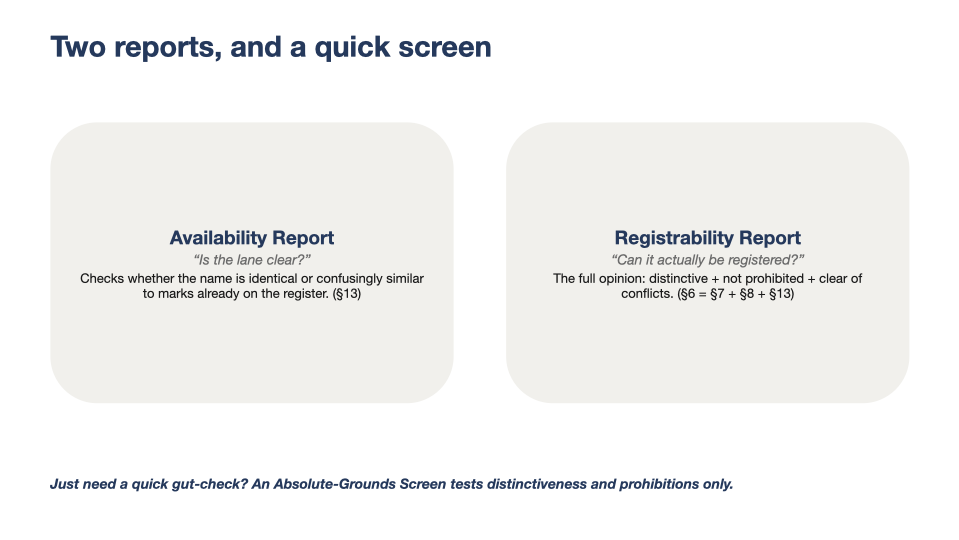
- “Is the lane clear?” → an Availability Report. This is the conflict search: is your mark identical or confusingly similar to an earlier registered, pending, or well-known mark in Thailand (§13)? For a foreign seller, this is also where you find out if a local partner has quietly filed your name. It’s the lighter, search-only product, and it’s usually the first thing to run.
- “Can it actually be registered?” → a Registrability Report. The full opinion under §6: is the mark distinctive (§7), not prohibited (§8), and clear of conflicts (§13)? A name that reads fine in English can be refused in Thailand for being descriptive once translated or transliterated. This is the report that answers the whole question.
- Just want a quick gut-check on whether the name is even the kind of thing that can be a trademark, before you search? That’s an Absolute-Grounds Screen (distinctiveness and prohibited-marks only). Useful early, but on its own it is not clearance to file, because it hasn’t checked for conflicts.
The honest rule: a clear search is not the same as a registrable mark, and a registrable-looking name is not cleared until it’s been searched. We match the report to where you are.
How long registration takes in Thailand
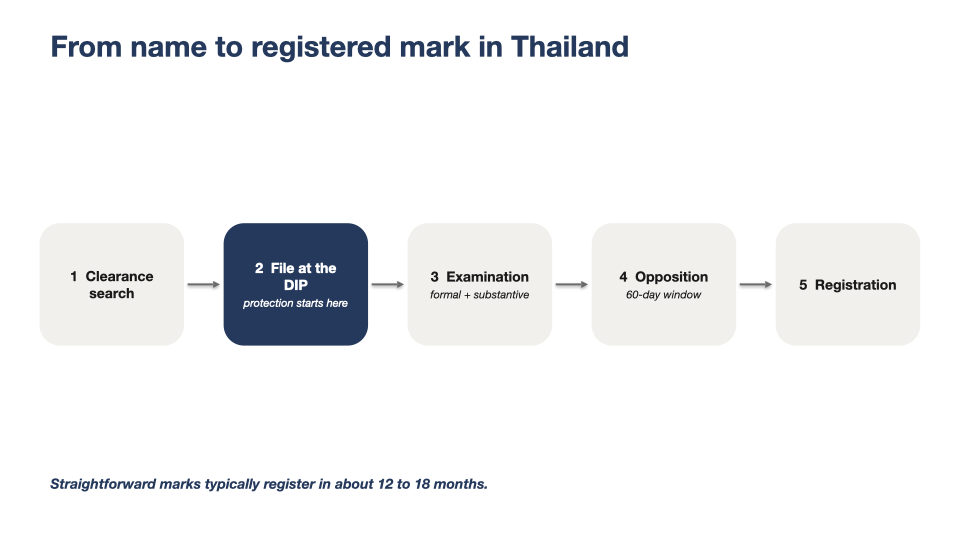
Roughly, the path runs: clearance search → file at the DIP → formal and substantive examination → published for opposition (a 60-day window) → registration. In straightforward cases that’s typically around 12 to 18 months. Two things matter more for a remote seller than the total wait:
- Your protection priority starts from the filing date, not the registration date. So the day you file is the day you get in line ahead of anyone who files after you. Waiting until sales are “big enough to bother” is waiting until you’re worth copying.
- The DIP fee is paid separately from lodging the application. Miss the fee deadline and the application can be treated as abandoned. We track that so it doesn’t lapse on a technicality while you’re a few time zones away.
Selling from abroad? The Madrid System is built for you
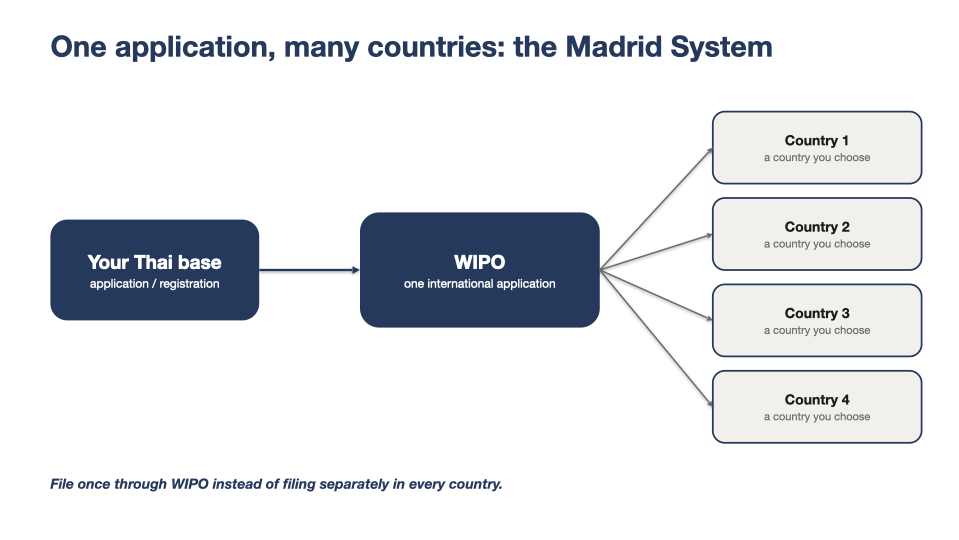
This is the block that matters most when you have no entity in Thailand. You don’t have to be a Thai company to protect your name here, and you don’t have to file country by country by hand. Thailand is a member of the Madrid Protocol (since November 2017). That means one international application, filed through WIPO and based on your home application or registration, can designate Thailand (and the other markets you sell into) in a single filing. For a brand selling into several countries from one base, it’s the difference between one coordinated filing and a stack of separate national ones. (Here’s how the Madrid System works in depth.)
Two more levers worth knowing:
- Paris Convention 6-month priority: a Thai filing made within six months of your home filing can claim that original date. If you filed at home recently, you may still be inside the window to backdate your Thai priority.
- You can also file directly at the DIP through local counsel without Madrid, which is often the cleaner route if Thailand is your main concern rather than one of many. We’ll tell you which path fits your footprint.
What we deliver
No parts list, just the destinations:
- Know if the name is still yours to claim in Thailand — the clearance search, done properly, by a lawyer, including whether a distributor or third party has already filed.
- Get it filed in your own name at the DIP — by Madrid designation or direct filing, specifications and classes handled, fee deadlines tracked so nothing lapses.
Not sure whether you need a quick search or the full opinion — or worried a partner already filed? Send me the name and I’ll tell you.
Who’s behind this
CorpJurist is a licensed Thai law firm. Your trademark work, the clearance search, the opinion, the filing, is handled and signed by a Thai-licensed lawyer with 14 years of practice. When you’re operating from abroad, that single, accountable point of contact, a Thai lawyer who answers you in English, is the whole point. The clearance and the filing are legal work a lawyer is accountable for, start to finish.
Plans
Straightforward packages, scoped to what you actually need:
- Availability Search — is the lane clear in Thailand, and has anyone filed it already, before you scale.
- Registrability Opinion — the full §6 answer: distinctive, not prohibited, clear of conflicts.
- File & Register — filing at the DIP in your own name, by Madrid designation or direct filing, with fee-deadline tracking.
Every package is fixed-scope with transparent inclusions and no lock-in. Request a quote and we’ll size it to your marks, markets, and classes.
Questions foreign sellers actually ask
“I don’t have a company in Thailand. Can I even own a trademark here?” Yes. You don’t need a Thai entity to own a Thai trademark. Foreign individuals and companies can hold registrations here, either by designating Thailand through the Madrid System or by filing directly at the DIP through local counsel. No entity, no local address of your own required to be the owner.
“My distributor offered to register it for me. That’s fine, right?” This is the classic way foreign brands lose their name here — filed in the distributor’s name, out of the goodness of their heart. If your partner holds the registration, they control your access to the market, and untangling it later can mean a court fight. Register in your own name. If a distributor genuinely needs to use the mark, that’s what a written, recorded licence is for, not ownership.
“Someone in Thailand already registered my name. Am I stuck?” Not necessarily, but it’s the hard road. A true owner may be able to petition the court to cancel a mark grabbed by someone else. It’s slower, costlier, and less certain than having filed first. Send it over and we’ll tell you honestly what your position looks like.
“I already have a trademark at home. Doesn’t that protect me in Thailand?” No. Trademarks are territorial. A US, EU, or UK registration gives you nothing on the Thai register on its own. What it can do is serve as the home base for a Madrid application that designates Thailand — so it’s useful, just not as protection by itself.
“I only sell on Lazada and Shopee. Do I really need this?” That’s often where it matters most. Marketplace IP-protection programs let a registered owner file takedowns. Without a Thai registration, you have little to enforce with — and worse, whoever does hold the registration can aim those same takedown tools at your listings.
Protect the name before the market does
The cheapest day to protect your brand in Thailand was the day your first order shipped here. The second cheapest is today, while the name is still unclaimed.
Send me the name and what you sell, and let’s get it cleared and filed in your name before a distributor or an opportunist beats you to it.
We’ll use the details you submit only to respond to your enquiry (PDPA B.E. 2562 (2019): notice, consent, lawful basis). This page is general information, not a legal opinion. Contact: info@corpjurist.com.
Send us your mark
Tell us your brand and what you sell, and a CorpJurist lawyer will come back to you on what protecting it takes.
Thanks — we've got it. A CorpJurist lawyer will get back to you about your mark.