You're entering Thailand. Is your brand name already taken here?
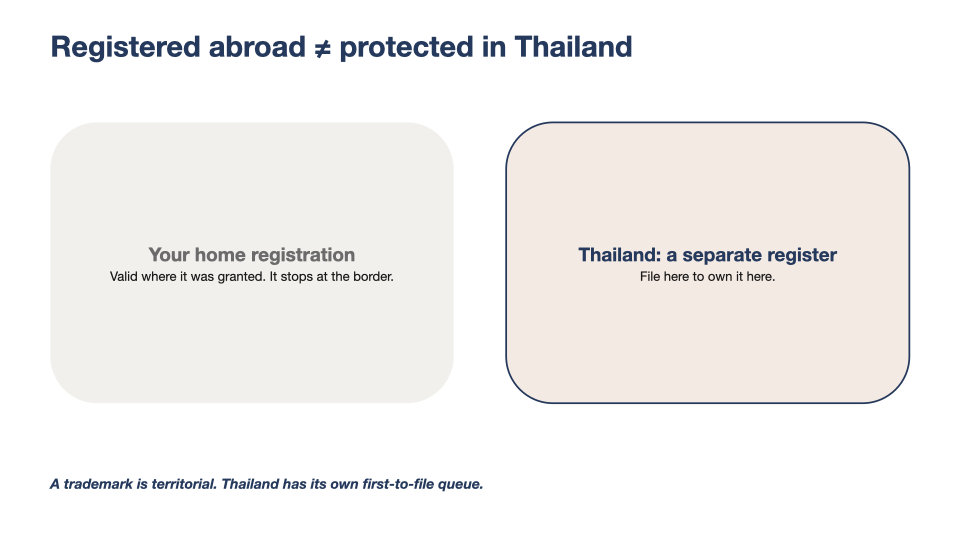
You’ve registered the trademark back home. Maybe in a dozen countries. So the name is yours, right? Not in Thailand. A trademark is territorial. It protects you only where it’s registered, and your home certificate stops at your home border. Thailand is a fresh register with its own rules and its own queue, and you may not be first in line.
This is a plain-English guide for foreign companies moving into Thailand: why your existing registrations don’t travel, how to check the name is actually free here before you launch, and the two roads to owning it (filing directly at the Thai DIP, or extending your international registration through the Madrid System).
Entering Thailand? Check the name first. Send us your brand name or logo and what you sell, and a Thai-licensed lawyer will tell you where it stands on the Thai register — and whether to file direct or via Madrid.
The trap that catches foreign entrants: first-to-file, and your certificate doesn’t count
Here’s the part that surprises almost every company arriving in Thailand. Thailand is a first-to-file country. Under the Trademark Act B.E. 2534 (1991), protection generally goes to whoever files the mark first in Thailand, not whoever used it first, and not whoever registered it somewhere else. Your ten-year-old registration in the EU, the US, or Singapore carries no weight on the Thai register. It’s a different jurisdiction, a blank sheet.
Now picture your actual timeline. You spend months on what a market entry demands: incorporating the company, BOI paperwork, a lease, hiring, a launch plan. That’s exactly the window in which someone else can file your name in Thailand. Sometimes it’s a would-be distributor. Sometimes it’s a squatter who watches foreign brands announce expansion and files first, betting you’ll pay to buy it back. Either way, you land, you’re ready to open, and the name over your own door belongs to a stranger.
From there every option is expensive: rebrand your Thai launch, buy back a name you already own everywhere else, or fight a cancellation action while your go-to-market slips. None of that is a good use of an entry budget.
The fix is cheap and boring, and it’s the same one locals use: search the name in Thailand, then file it, ideally before you announce and well before you open. Done early, it’s a line item. Done late, it’s a dispute.
One caveat worth knowing: first-to-file isn’t a shield for bad faith. Thailand has been a member of the Paris Convention for the Protection of Industrial Property since 2008 (accession 2 May 2008; in force 2 August 2008), which commits it to protecting well-known marks and acting against bad-faith copying, reinforced in Thai law by the well-known-mark ground (§8(10)) and the court’s power to cancel a wrongly-held registration on a better-right claim (§67). And the courts are using it: in a 2026 decision reported by Thai media, the coffee chain Luckin Coffee defeated a local company that had registered its name and logo, winning cancellation of those registrations, an order to stop using the mark, and damages (reported at over 95 million baht), with the ruling expressly treating bad-faith registration as a ground. That’s genuinely good news if your brand is well known abroad, but read the fine print: it was a multi-year court battle won by a globally recognised name. Proving bad faith or fame is slow, costly, and uncertain, which is exactly why landing with the mark already filed, so you never have to, stays the cheap option.
Send us your mark before you land
Before you print signage, localise the packaging, or brief a Thai agency, it’s worth knowing the name is actually free to take in Thailand — your home registration doesn’t carry here. Send us the name or logo and what you sell, and a Thai-licensed lawyer will come back to you: whether the name looks clear on the Thai register, whether to file directly at the DIP or designate through Madrid, and which entity should own it. From there, the clearance and the filing are the work a lawyer signs.
Email us your mark. Tell us the name and your target markets, and we’ll come back with the road that fits your entry.
Search vs filing: why searching first is the cheap insurance
Two different jobs, and companies in a hurry to launch skip the first one:
- A trademark search (clearance) looks before you commit, to answer “is this name actually available and protectable in Thailand?”
- A trademark filing is the application itself — lodged at the DIP (Department of Intellectual Property), either directly or through the Madrid route below.
Filing without searching, in a first-to-file country, is how a company pays for an application that gets refused, or that sails through and then draws a conflict from an earlier Thai owner. For an entrant the risk is sharper: your name may be well known abroad and still collide with something local you’ve never heard of. The search is the small spend that stops the big one.
Two reports, and a quick screen
Not every entry needs the same depth. It comes down to which question you’re actually asking:
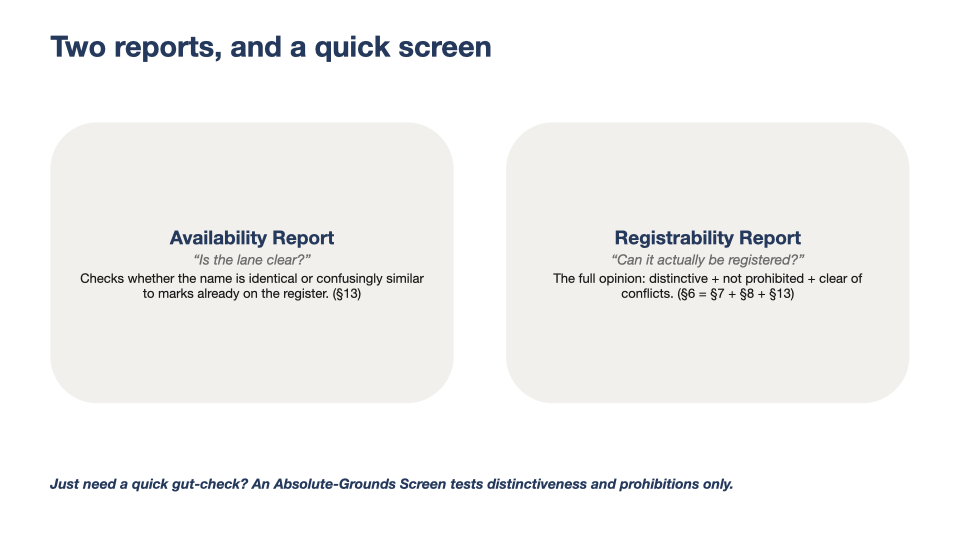
- “Is the lane clear?” → an Availability Report. This is the conflict search: is your mark identical or confusingly similar to an earlier registered, pending, or well-known mark in Thailand (§13)? It’s the lighter, search-only product, and for most companies choosing a Thai launch name it’s the first thing to run.
- “Can it actually be registered?” → a Registrability Report. The full opinion under §6: is the mark distinctive (§7), not prohibited (§8), and clear of conflicts (§13)? A name that’s fine at home can be refused here for being descriptive in Thai, or for a translation or transliteration you’d never think to check. This is the report that answers the whole question.
- Just want a quick gut-check on whether the name is even the kind of thing that can be a trademark in Thailand, before you search? That’s an Absolute-Grounds Screen (distinctiveness and prohibited-marks only). Useful early, but on its own it is not clearance to file, because it hasn’t checked for conflicts.
The honest rule: a clear search is not the same as a registrable mark, and a registrable-looking name is not cleared until it’s been searched. We match the report to the moment you’re in.
How long registration takes in Thailand
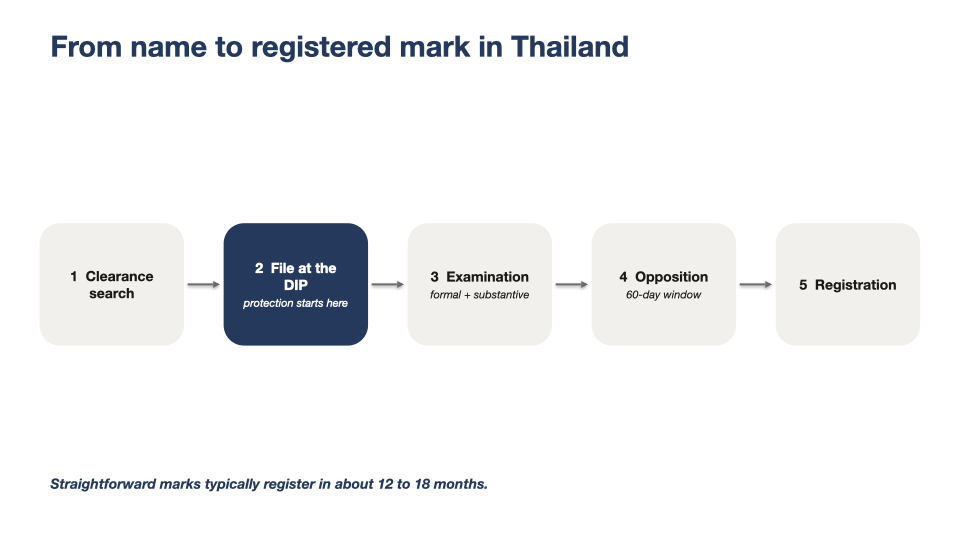
Roughly, the path runs: clearance search → file at the DIP → formal and substantive examination → published for opposition (a 60-day window) → registration. In straightforward cases that’s typically around 12 to 18 months. Two things worth knowing when you’re timing an entry:
- Your protection priority starts from the filing date, not the registration date. You don’t have to wait out the full pendency to be protected, so filing early plants your flag. That’s the whole argument for filing before the launch noise starts.
- The DIP fee is paid separately from lodging the application. Miss the fee deadline and the application can be treated as abandoned. We track it so nothing lapses on a technicality while your team is heads-down on the launch.
One entrant-specific note: a foreign applicant without a place of business in Thailand generally files through a local agent or representative in Thailand, appointed by power of attorney. If you’re incorporating a Thai entity as part of your entry, that entity can usually be the applicant instead. Which name you file under is worth deciding on purpose, not by default.
Two roads into Thailand: file directly, or designate via the Madrid System
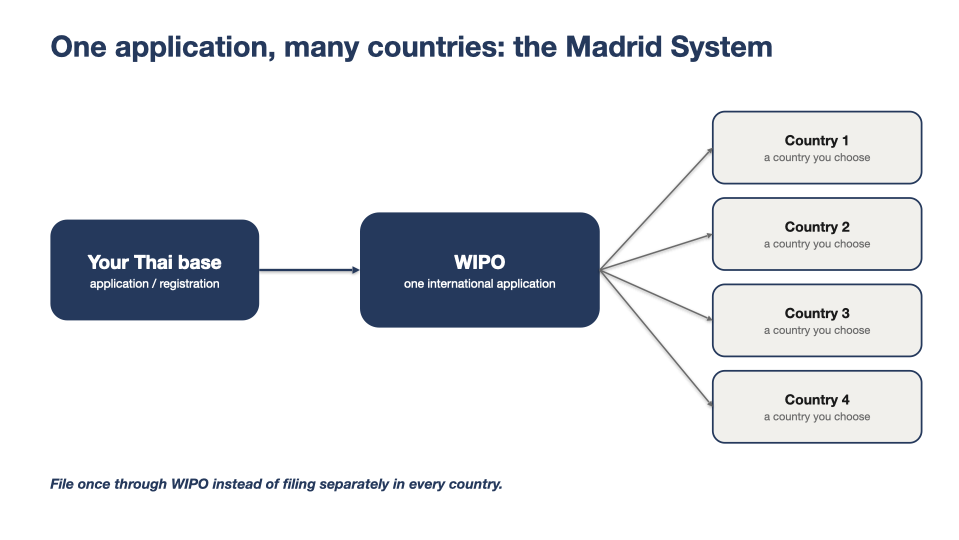
For a company that already owns the mark abroad, this is the block that matters most. There are two ways onto the Thai register:
- File nationally at the DIP. A direct Thai application, examined under Thai law. Cleanest when Thailand is your main event, when you want the application in your new Thai entity’s name, or when the specification needs tuning to Thai classification practice.
- Designate Thailand through the Madrid Protocol. Thailand joined the Madrid Protocol (effective November 2017). If you already hold a home (basic) application or registration, you can file one international application through WIPO and add Thailand as a designated country, instead of a standalone Thai filing. It’s efficient when Thailand is one of several markets you’re entering in the same push, and it keeps the portfolio under one roof for renewals later. (We explain how the Madrid System works end to end if you’re weighing it.)
Two things every entrant should hear plainly. First, Madrid is a filing route, not a shortcut past Thai examination. Once you designate Thailand, the DIP examines the mark under the same Thai law (the same §7 distinctiveness, §8 prohibitions, and §13 conflicts) and can issue a provisional refusal you’ll have to answer locally. So a Thai conflict search before you designate is just as smart as before a direct filing; Madrid doesn’t clear the lane for you. Second, if you’re filing a fresh foreign application around the same time, the Paris Convention’s 6-month priority lets a later filing claim your original filing date, which keeps a gap from opening between your home filing and your Thai one.
Which road is right depends on how many markets you’re entering, whether you want the mark under a Thai entity, and how your existing portfolio is set up. It’s a short conversation, and we’ll point you to the cheaper-for-you answer.
What we deliver
No parts list, just the destinations:
- Know if your name is free in Thailand before you commit your launch to it: a proper Thai clearance search by a lawyer who reads the register, not a keyword lookup.
- Get it filed and registered by the road that fits your entry, directly at the DIP or via Madrid designation, with classes handled and fee deadlines tracked so nothing lapses.
Not sure whether to file directly or designate Thailand through Madrid? Send me the name and your target markets and I’ll tell you.
Who’s behind this
CorpJurist is a licensed Thai law firm. Your trademark work, the clearance search, the opinion, the filing, is handled and signed by a Thai-licensed lawyer with 14 years of practice. For a foreign company, that means the person reading the Thai register and answering the DIP examiner is a Thai lawyer you brief directly, in English, from day one. The clearance and the filing are legal work a lawyer is accountable for, start to finish.
Plans
Straightforward packages, scoped to what a market entry actually needs:
- Availability Search — is the lane clear in Thailand before you commit your launch to the name.
- Registrability Opinion — the full §6 answer: distinctive, not prohibited, clear of conflicts, in the Thai context.
- File & Register — end-to-end filing, direct at the DIP or via Madrid designation, with fee-deadline tracking.
Every package is fixed-scope with transparent inclusions and no lock-in. Request a quote and we’ll size it to your marks, your classes, and the markets you’re entering.
Questions foreign entrants actually ask
“We’re already registered in [our country] and several others. Doesn’t that cover Thailand?” No. Trademarks are territorial. Your foreign registrations protect you where they’re filed, and Thailand isn’t on that list until you file here. It’s a separate register with its own first-to-file queue.
“We use the Madrid System already. Can we just add Thailand?” Often yes, and it can be the efficient route. But designating Thailand still puts your mark in front of a Thai examiner who applies Thai law and can refuse it. Search Thailand first either way. Madrid moves the paperwork; it doesn’t clear the ground.
“Do we file under our home company or the new Thai entity we’re setting up?” That’s a real choice, with consequences for control, licensing, and how you’re represented at the DIP. A foreign applicant without a Thai place of business generally files through a local agent; a Thai entity can file in its own name. We’ll help you pick before you file, not after.
“Our name is well known globally. Isn’t it protected as a well-known mark?” Thai law does recognise well-known marks, but relying on that is a fight, not a plan. You’d be arguing the point after someone else has filed. Owning the registration is cheaper and quieter than proving fame.
“What if a distributor or partner offers to register it for us locally?” Be careful here. The mark should sit with you, not with a local partner who could hold it over the relationship. (Selling into Thailand through a distributor without setting up here is its own situation, with its own risks, and worth a separate conversation.)
Land with the name already yours
The cheapest time to secure your brand in Thailand is before you announce you’re coming. The second cheapest is today, while the register is still clear.
Send me the name and your target markets, and let’s get it cleared and filed — direct or via Madrid — before your entry makes the name worth taking.
We’ll use the details you submit only to respond to your enquiry (PDPA B.E. 2562 (2019): notice, consent, lawful basis). This page is general information, not a legal opinion.
Send us your mark
Tell us your brand and what you sell, and a CorpJurist lawyer will come back to you on what protecting it takes.
Thanks — we've got it. A CorpJurist lawyer will get back to you about your mark.